Notes
Slide Show
Outline
1
Chapter 26:  An Introduction
to Chromatographic Separations
  • Column Chromatography
  • Migration Rates
    • Distribution Contstants
    • Retention Times
    • Selectivity Factor
  • Zone Broadening & Column Efficiency
  • Optimizing Performance
  • Resolution
2
Intro to Chromatography
  • Chromatography is a separation technique
  • HPLC & GC are our primary focus
  • Also discuss low pressure column chromatography & TLC (thin layer)
  • All chromatographic techniques have
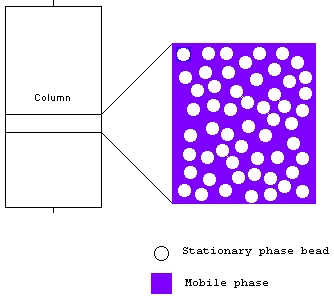
    • Stationary phase – solid or viscous liquid phase typically in a column
    • Mobile phase – moves sample in contact with stationary phase
3
 
4
"Partitioning = type of equilibrium..."
  • Partitioning = type of equilibrium where the analyte divides itself between two phases


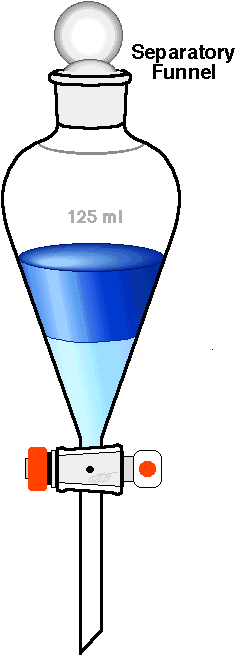
  • For liquid-liquid extraction – two liquids
  • For chromatography – mobile vs. stationary phases


  • Define a partition ratio K (or distribution constant)


  •                   Cs               where Cs & CM are
  •          K = -------
  •                   CM         concentrations of analyte in


  •                                 stationary & mobile phases
5
"Prefer if K is constant..."
  • Prefer if K is constant over conc. range
  • If not constant we can work in a narrow range where it is constant
  • This is linear chromatography


  • Example of non-linear chromatography
    • Pour aqueous solution of A & B on column
    • Allow water to drain out, both A & B stick
    • Wash column with 50% MeOH, A removed
    • Wash column with 100% MeOH, B removed
  • Used extensively for sample cleanup in GC
6
"From now on everything is..."
  • From now on everything is linear chromatography
  • In linear chromatography a constant flow rate of mobile phase moves through column
  • K is typically constant or nearly constant
  • Elution = process by which analyte is flushed through the column by mobile phase (which could be a liquid or a gas)


7
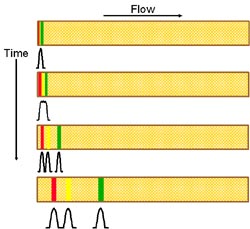
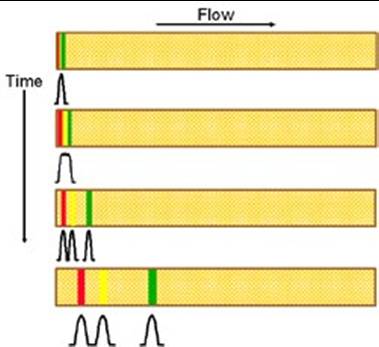
"Overview of"
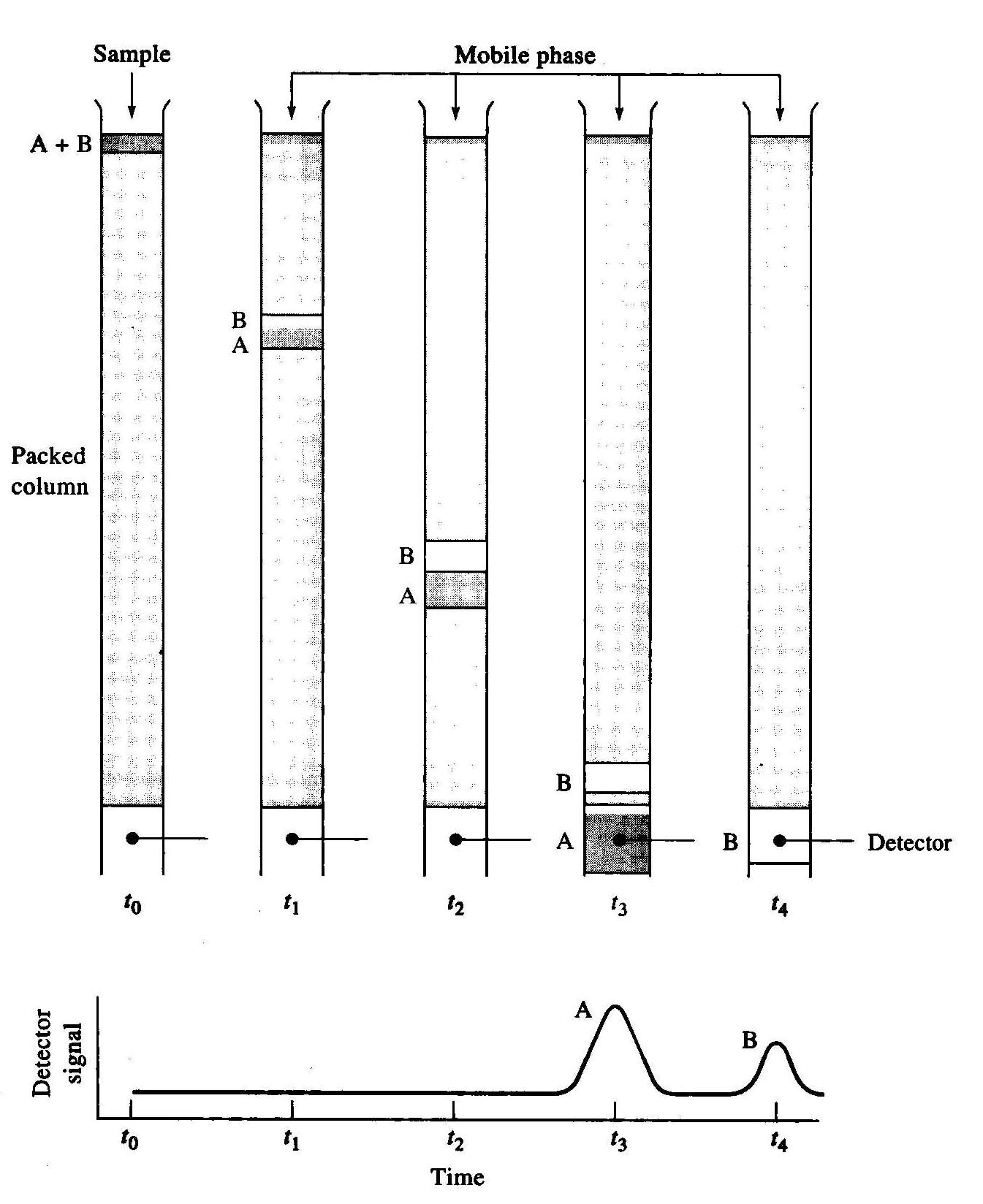
  • Overview of
  • chromatographic
  • process – packed
  • column
  • - Inject at to
  • - Separate t1 to t3
  • - Detect at t4
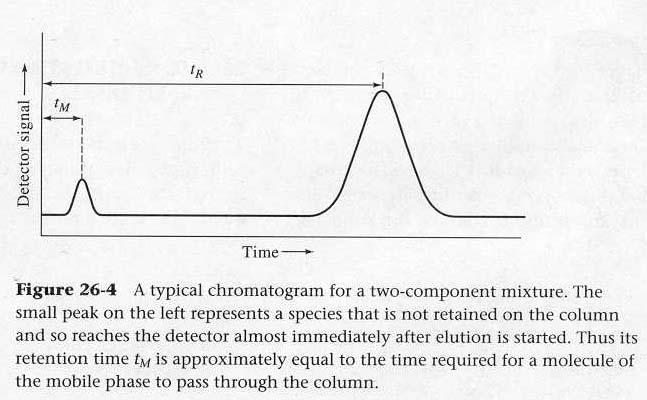
  • Resulting
  • chromatogram
8
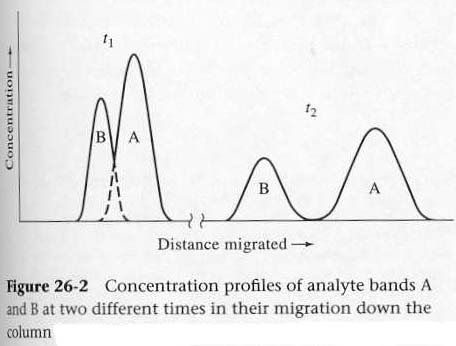
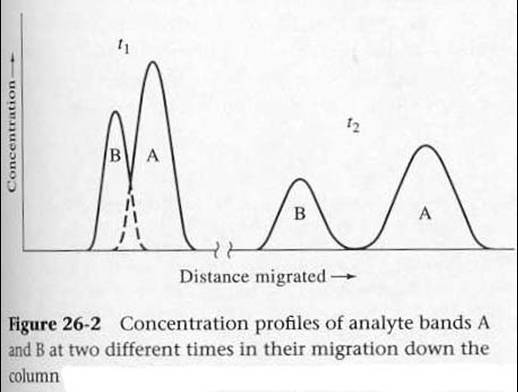
"A & B retained by..."
  • A & B retained by column differently
  • B has higher K
  • B takes longer to elute from column
  • Detector sees A first then B
  • Peak heights & peak areas are proportional to conc.
  • Band broadening
9
 
10
 
11
 
12
"Define n as average linear..."
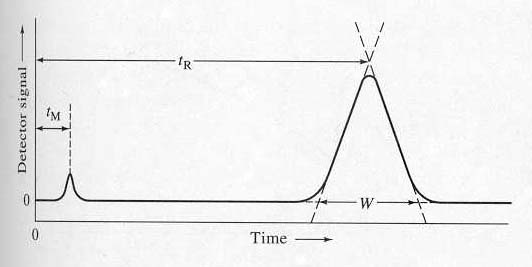
  • Define n as average linear rate of solute migration & L as column length, then


  •                       L             distance
  •               n = -----           ------------ = velocity
  •                       tR               time


  • Similarly if define µ as average linear rate of movement of molecules of mobile phase
  •                       L
  •               µ = -----
  •                       tM
13
 
14
"Relating retention time tR to..."
  • Relating retention time tR to K (= Cs/CM)
  • n = µ x fraction of time analyte is in mobile phase


  •              moles of analyte in mobile phase
  • n = µ x ---------------------------------------------
  •                  number of moles of analyte


  •                    CM VM                           1
  • n = µ x -------------------- = µ x ---------------------
  •              CM VM + Cs Vs           1 + CsVs/CMVM


  • Substituting  K = Cs/CM


  •                                                    1
  • Gives                     n = µ x ------------------
  •                                             1 + K Vs/VM
15
"More useful relationships - capacity..."
  • More useful relationships - capacity factor k’
  • (comes from K) K in concentration, k’ in moles


  •            amount of analyte in stationary phase
  •    k’ = ----------------------------------------------
  •              amount of analyte in mobile phase


  •                                    KAVs          ns            n = # of
  • So for A  à    kA’  =  ----------  =  ------         moles
  •                                      VM           nM
16
"From previous"
  • From previous
  • equation à


  • Can plug in    n = L/tR   &   µ = L/tM


  • Rearrange                        tR – tM
  •                              kA’ = -----------
  • and get                                tM


  • Now have kA’ in terms of something easily measured in chromatogram
  • Compares how long it takes a species to move through system compared to unretained species
  • Relative because ratio, Numerator = Net Retention
17
"One step further à Selectivity..."
  • One step further à Selectivity factor (a) describes differential migration


  • For two                             KB          kB’
  •                                 a = ------  =  -------
  • components                       KA          kA’


  • And from                              (tR)B - tM
  •                                   a = ---------------
  • chromatogram                      (tR)A – tM


  • Allows calculation of the resolving power of


  • a chromatographic system (i.e. column with A & B)
18
Chromatographic Plate Theory vs. Rate Theory
  • Plate theory based in liquid-liquid extraction (successive extractions)
  • K = Corg/Cwater
  • Chromatographic column can be     thought of in the same way (only continuous process)
  • K = Cs/CM


19
"Divide chromatographic column up into..."
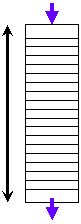
  • Divide chromatographic column up into steps or segments called theoretical plates
  • The theoretical concept is that these theoretical plates are equilibrium units for K = Cs/CM
  • The more theoretical plates a column has, the more efficient it is
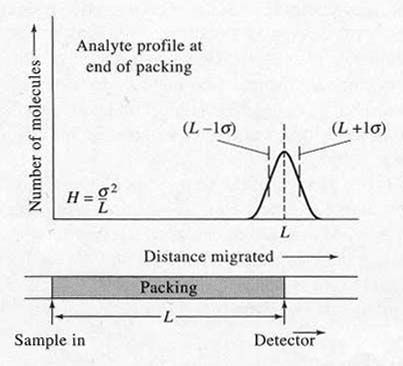
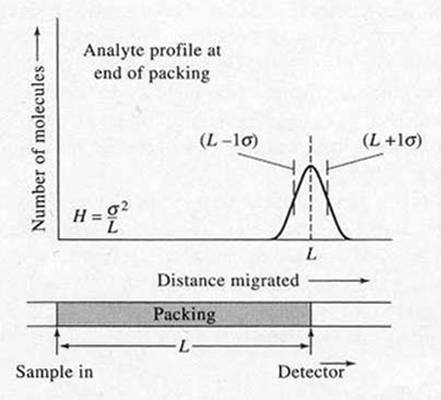
  • If column length = L & N = number of plates, then H = height equivalent to theoretical plate
20
"Gausian"
  • Gausian
  • peaks –
  • statistical
  • distribution
  • of
  • molecules
  • Wb = 4s
21
"Gausian distribution (bell curve"
  • Gausian distribution (bell curve)
  • W = 4s
22
"Can derive"
  • Can derive                    N = number of plates


  •     N = 16 (tR/Wb)2                Wb = base width


  •     N = 16 (tR/4s)2   = (tR/s)2


  •     N = 5.54 (tR/W½)2                 W½ = width at
  •                                                      half height
  • Column manufacturers use N
  • to characterize column – N varies widely
23
"Shortcomings of Plate Theory"
  • Shortcomings of Plate Theory
  • Assumes K is independent of concentration
  • Assumes equilibration is rapid relative to velocity of mobile phase – not true, in reality solute may pass a plate without entering
  • Assumes no longitudinal diffusion (= non ideal effect that causes band broadening)
  • Does not address several factors caused by mobile phase velocity (fast or slow) Rate Theory
  • Assumes discrete units or plates for equilibrium rather than a semi continuous process through the column