|
1
|
- Principles
- Instrumentation
- Detectors
- Columns and Stationary Phases
- Applications
|
|
2
|
- Basic Principle of GC – sample
- vaporized by injection into a
- heated system, eluted through
- a column by inert gaseous mobile
- phase and detected
- Three types (or modes)
- gas – solid chromatography
early
- gas – liquid “
important
- gas – bonded phase “
relatively new
- An estimated 200,000 GC in use worldwide
|
|
3
|
|
|
4
|
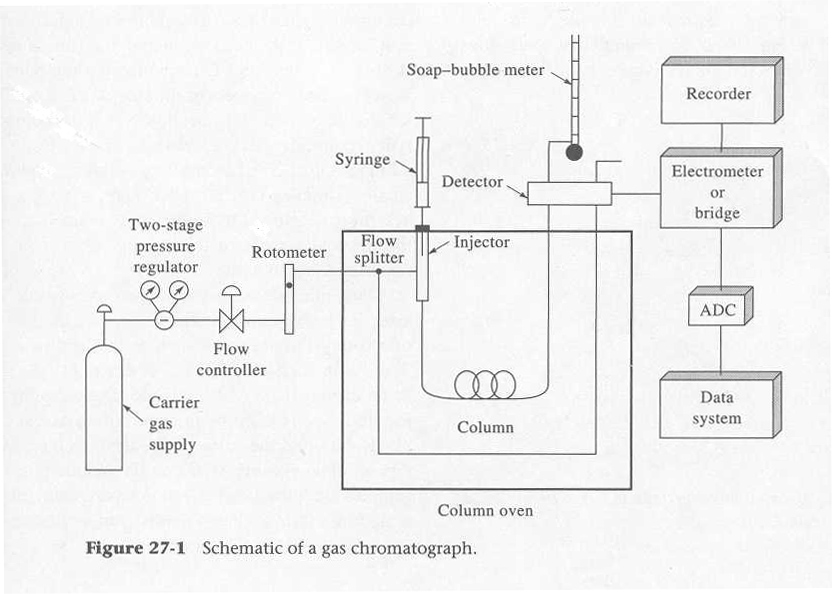
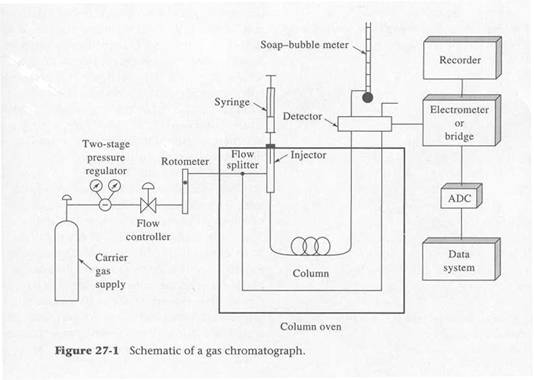
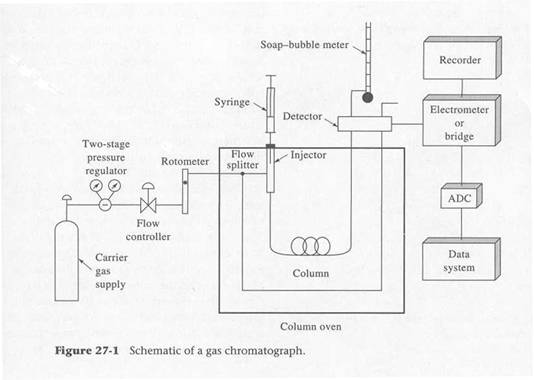
- Carrier gases (mobile phase) – must be chemically inert He, Ar, N2,
CO2 even H2 and mixtures 95/5 N2/CH4
- Often detector dictates choice of carrier gas
- In GC sample doesn’t really interact with carrier gas (unlike HPLC),
temp controls partitioning
- Often necessary to purify cylinder gas with a trap, scrubber or
cartridge of molecular sieves (or buy high purity gas) O2 ppm
Hc
- The move today is away from gas cylinders toward gas generators (extract
pure carrier gas from air)
|
|
5
|
|
|
6
|
- Flow control – 10 to 50 psi with regulator
- Regulators vary in quality, material & control, typically use a 2
stage regulator with the best material being stainless steel
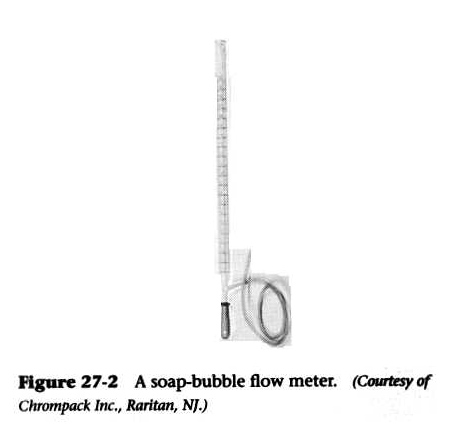
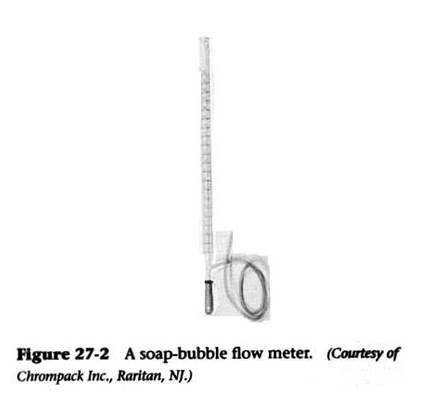
- Ultimately flow rate is checked by a soap bubble meter for accurate flow
|
|
7
|
|
|
8
|
|
|
9
|
|
|
10
|
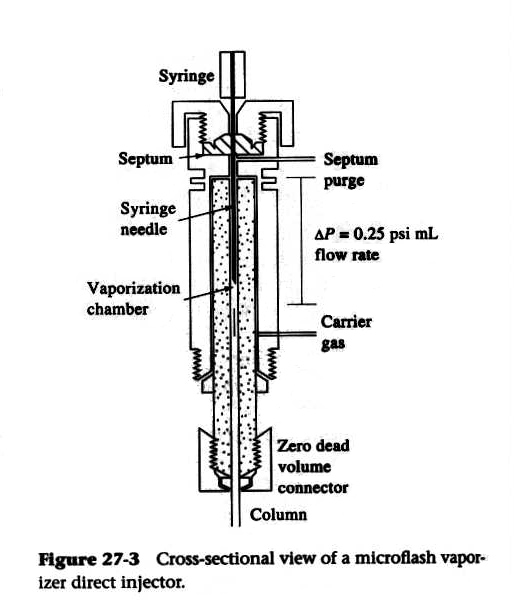
- Injector – use micro syringe 99.9 % of the time injecting 1 to 20 µL,
rapidly shoot in plug of sample
- Old GCs had separate injection area
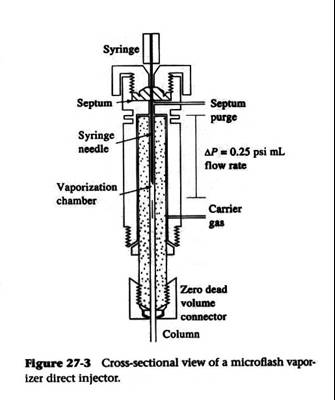
- Today use on-column & microflash vaporizers – all have septum of
synthetic rubber which is punctured by syringe
- Injector usually 50 oC hotter than boiling point of sample –
also hotter than column
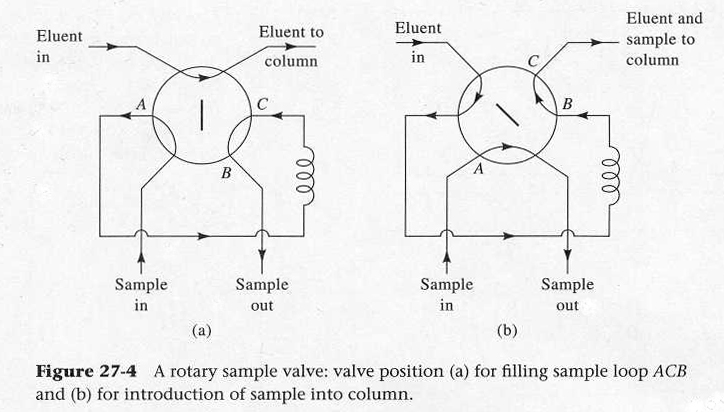
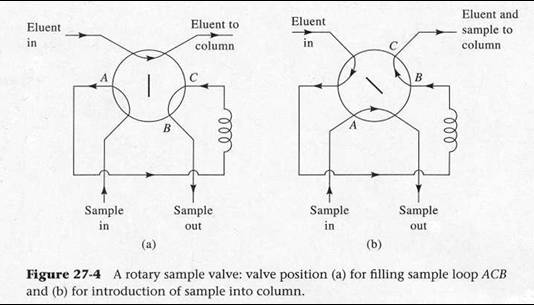
- Can use rotary injector valve (as for HPLC)
|
|
11
|
- Rotary Injection Valve
- Common for HPLC, rare in GC
|
|
12
|
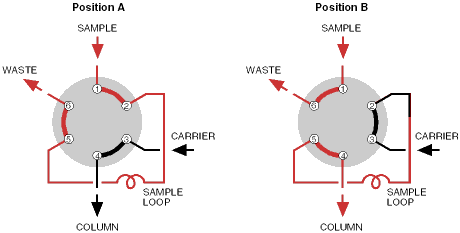
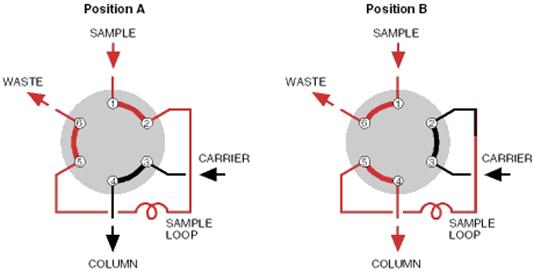
- Alternate view of injector valve
- Position A = Load (i.e. fill loop)
- Position B = Inject (sample swept onto column)
|
|
13
|
|
|
14
|
- Column housed in Column Oven to maintain temperature
- Types – packed, open tubular, capillary
- oldest
------------------ newest
- Capillary columns will take over completely
- Packed – tube (steel, glass, fused silica, Teflon) packed with material
- Open Tubular – coated on walls
- Capillary – coated on walls, long & narrow
- Length range – 2 to 50 m (typically 30 m)
|
|
15
|
- Column Concepts
- In GC since mobile phase is under pressure & we operate at various
temperatures
- given that P V is proportional to T
- Sometimes use retention volumes (VR, VM)
- VR = tR
F for retained species tR
= retention
-
time
- VM = tM
F for unretained F = flow rate
|
|
16
|
- Problem - pressure drop across a column
- Pressure at head of column may be 5 atm & at end of column may be 1
atm
- Need a correction factor
- 3[(Pi/P)2
-1]
- j =
------------------
- 2[(Pi/P)3
– 1]
- Where Pi = inlet pressure &
- P = outlet pressure
(atmospheric)
|
|
17
|
- Can define specific retention volume (Vg)
- VRo
– VMo
273
- Vg =
--------------- x -------
- W Tc
- Where W = mass of stationary phase
- Tc = column
temp. (oK)
- VRo
= j tR F VMo
= j tM F
- Can relate Vg to K (partition ratio)
- K 273 W
- Vg = ---- x
------- rs = ------
- rs Tc Vs
|
|
18
|
- Detectors – dozens of detectors available
- Characteristics of an ideal detector:
- Adequate sensitivity for desired analysis (typical 10-8 to 10-15
g analyte/sec)
- Stable – background constant with time
- Reproducible – good precision
- Linear response over several orders of magnitude
- Temperature range – room temp - 400 oC
|
|
19
|
- Characteristics of ideal detector: (continued)
- 6) Rapid response time
- 7) Independent of flow rate
- 8) Reliable
- 9) Easy to Use – inexperienced operators
- 10) Either selective or universal response
- 11) Nondestructive
- No detector exhibits all these characteristics
|
|
20
|
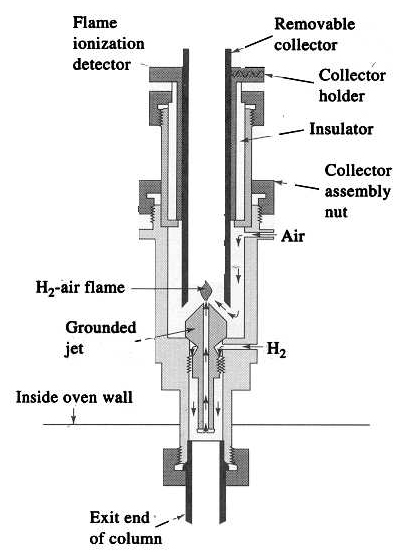
- Flame Ionization Detector (FID)
- - one of most widely used GC detectors
- - good sensitivity to almost all organic compounds
|
|
21
|
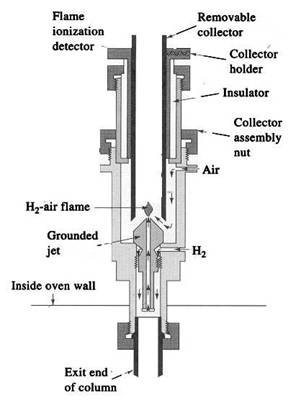
- FID Basics
- - column effluent mixed with air and burned in H2 flame
producing ions & electrons that conduct electricity
- a few hundred volts applied between burner tip & a collector
electrode above the flame producing currents on the order of 10-12
amps
- amplify & measure
- signal approximately proportional to number of reduced carbon atoms in
flame
|
|
22
|
- FID Basics (continued)
- mass sensitive rather than concentration
- insensitive to non combustible gases – H2O, CO2,
SO2, NOx
- FID exhibits
- High sensitivity
- Large linear response range 10-13 g/s
- Easy to use
- Rugged
- DESTRUCTIVE
|
|
23
|
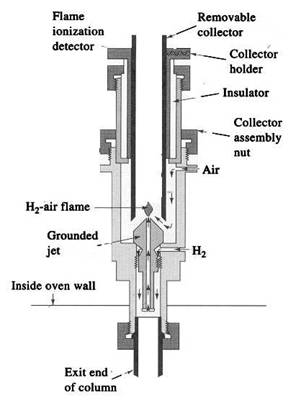
- Flame Ionization Detector (FID)
- - one of most widely used GC detectors
- - good sensitivity to almost all organic compounds
|
|
24
|
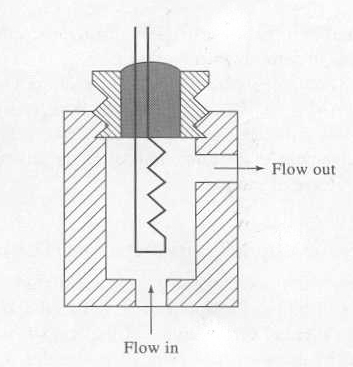
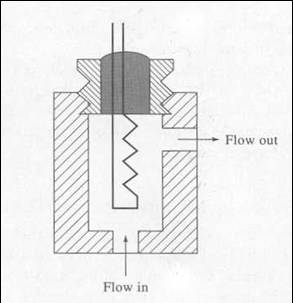
- Thermal Conductivity Detector (TCD)
- One of earliest GC detectors
- Not popular today
- Low sensitivity
- Several designs
- Use heated wire or semiconductor
- - Resistance of wire changes with analyte vs carrier
|
|
25
|
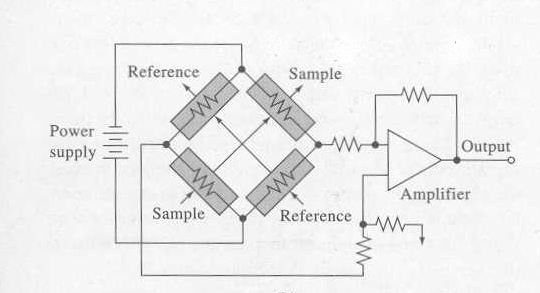
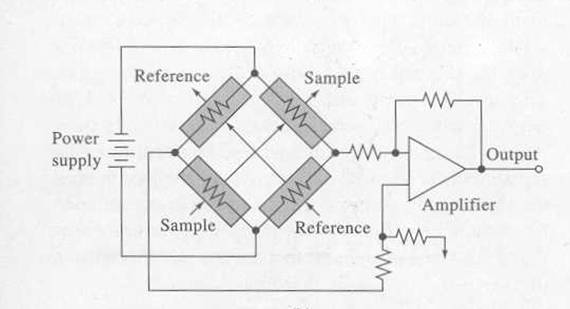
- TCD uses bridge circuit with
- Sample & Reference Cells
|
|
26
|
- TCD
- New TCDs use pulsed current to increase sensitivity & reduce drift
- Thermal conductivity of He & H2 are about 6 to 10 times
greater than most organic compounds (must use these carrier gases)
- Other carrier gases (N2, Ar, etc) have thermal conductivities
too close to organics
|
|
27
|
- Advantages of TCD
- Simple à Reliable &
Easy to use
- Universal response (organic & inorganic)
- Large linear dynamic range 105
- Nondestructive, can use in tandem
- Older instruments have built-in TCD
- Disadvantages
- Low sensitivity
- Often can’t use with capillary columns because amount of analyte is
small
|

 Notes
Notes