|
1
|
- General Properties of Electromagnetic Radiation (EM)
- Wave Properties of EM
- Quantum-Mechanical Properties of EM
- Quantitative Aspects of Spectrochemical Measurements
|
|
2
|
|
|
3
|
- Spectroscopy = methods based on the interaction of electromagnetic
radiation (EM) and matter
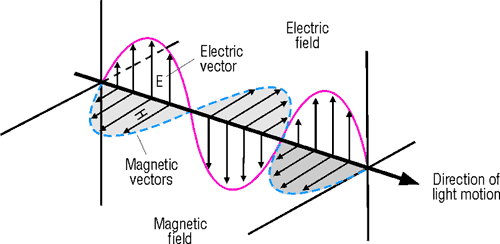
- Electromagnetic Radiation = form of energy with both wave and particle
properties
- EM moves through space as a wave
|
|
4
|
- Relationship between various wave properties
-
C
- n λi =
-----
- ηi
- Where n = frequency in
cycles/s or Hz
- λi =
wavelength in medium i
- ηi = refractive index of medium i
- C = speed of light in vacuum
(2.99 x 1010 cm/s)
- EM slows down in media other than vacuum because electric vector
interacts with electric fields in the medium (matter) à this effect is greatest in
solids & liquids, in gases (air) velocity similar to vacuum
|
|
5
|
- Wave Equation
- y = A sin
(wt + a)
- Where A = amplitude
- w = angular frequency
- a = phase angle
- t = time
- For a collection of waves the resulting position y at a given t can be
calculated by
- y = A1 sin (w1t
+ a1) + A2
sin (w2t + a2) + …
|
|
6
|
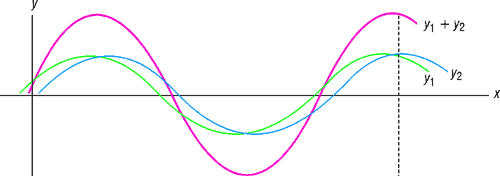
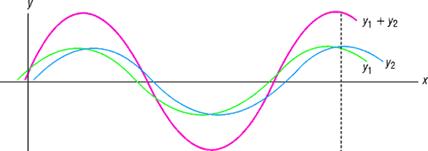
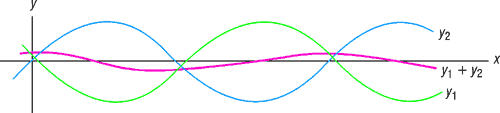
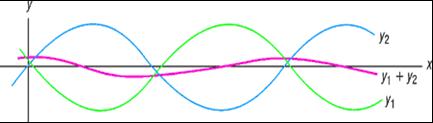
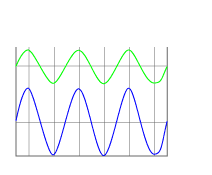
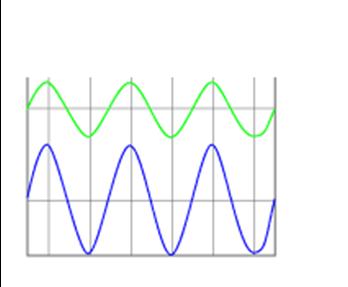
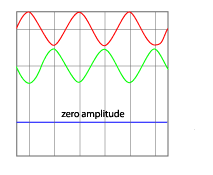
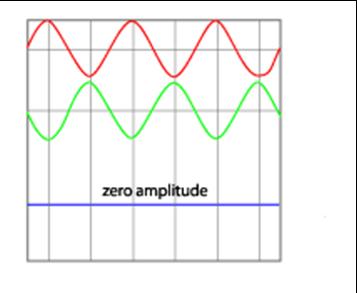
- Interference - amplitude of the resulting wave depends on phase
difference a1 - a2
|
|
7
|
- At a1 - a2 = 0o adding
of waves gives Maximum Constructive Interference
|
|
8
|
- When a1 - a2 = 180o or
540o adding of waves gives Maximum Destructive Interference
|
|
9
|
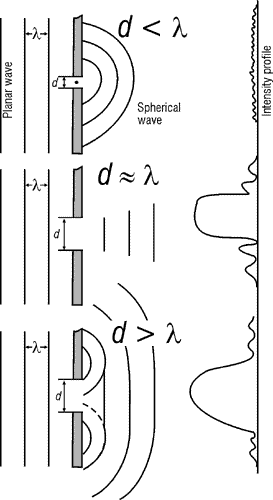
- Diffraction = EM going past an edge or through a slit (2 edges) tends to
spread
|
|
10
|
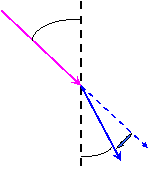
- Refraction = change in velocity of EM as it goes from one medium to
another
|
|
11
|
- Equation for Refraction (Snell)
- sin Ф1 n1 η2 if medium
1
- ---------- = -----
= ------ =
η2
- sin Ф2 n2 η1 is air η1
= 1.0
- Magnitude of the direction change (i.e., size of the angle depends on
wavelength (shown in equation as n) this is how a prism works
- Direction of bending depends on relative values of η for each
medium. Going from low η to
higher, the ray bends toward the normal.
Going from higher η to lower the ray bends away from the
normal.
|
|
12
|
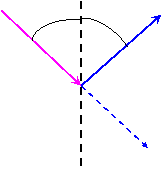
- Reflection = EM strikes a boundary between two media differing in η
and bounces back
- Specular reflection = situation where angle of incidence (θi)
equals angle of reflection (θr)
|
|
13
|
-
Ir (η2
- η1)2
- Reflectance =
R = ---- =
--------------
-
Ii (η2
+ η1)2
- Where Ii and Ir = incident & reflected
intensity
- For radiation going from air (η = 1.00) to glass (η = 1.50) as
shown in previous slide
- R = 0.04
= 4 %
- Many surfaces at 4 % each (i.e., many lenses) can cause serious light
losses in a spectrometer. This
generates stray radiation or stray light.
|
|
14
|
- Scattering = EM interacts with matter and changes direction, usually
without changing energy
- This can be described using both the wave or particle nature of light:
- Wave – EM induces oscillations in electrical charge of matter Þ resulting in oscillating dipoles
which in turn radiate secondary waves in all directions = scattered
radiation
- Particle (or Quantum) – EM interacts with matter to form a virtual state
(lifetime 10-14 s) which reemits in all directions.
- Raman effect = when some molecules return to a different state Þ change in frequency
|
|
15
|
|
|
16
|
- Rayleigh Scattering – scattering by particles whose longest dimension is
< 5 % to 10 % of λ with no change in observed frequency
- 8 π4
a2
- Is =
------------ (1 + cos2 θ) Io
- λ4
r2
|
|
17
|
- Polarizability (a) is measure
of how well a given frequency induces a dipole in a substance
- Tends to be large for large molecules (e.g., proteins)
- Large Particle Scattering – particle dimensions < 10 % λ to 1.5 λ
- Applies in techniques like turbidimetry and nephelometry
- Large particles do not act as a point source & give rise to various
interference phenomena
- Forward scatter becomes greater than back scatter
|
|
18
|
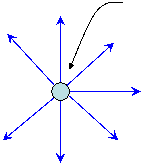
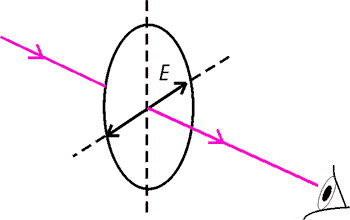
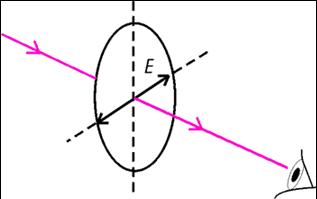
- Polarization
- EM is said to be unpolarized if its electric vectors and magnetic
vectors occur with equal amplitude in all direction
|
|
19
|
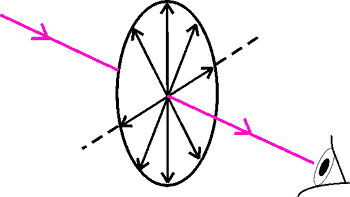
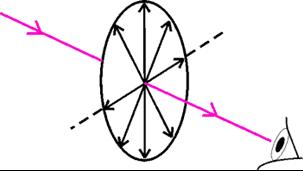
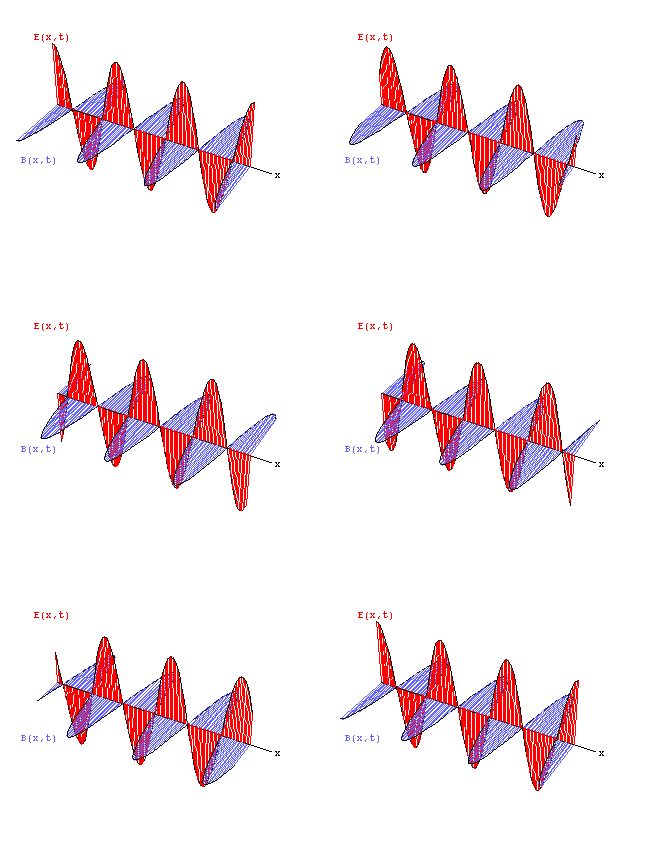
- Linearly polarized light oscillates in one plane only as it moves
through space
|
|
20
|
- Linearly polarized light oscillates in one plane only as it moves
through space
|
|
21
|
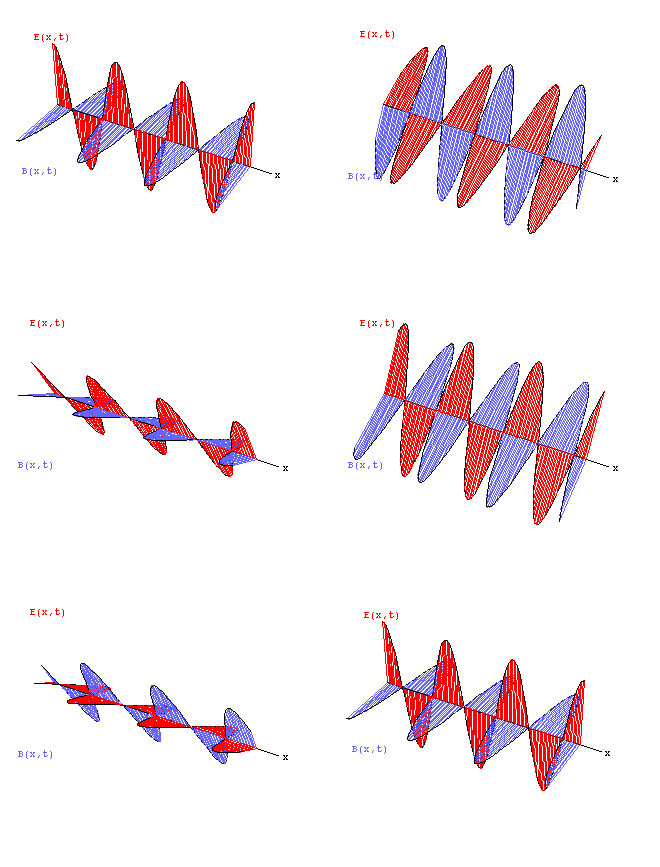
- Circularly polarized light rotates in either a left handed or right
handed spiral as it moves through space
|
|
22
|
- Combining equal beams where one is right circularly polarized and the
other left, results in linearly polarized radiation
- Polarization is particularly important for studying optically active
materials using
- - Optical Rotatory Dispersion (ORD)
- - Circular Dichroism (CD)
- - Fluorescence Polarization
|
|
23
|
- Absorption and Emission
- Two most interesting and most useful processes when EM interacts with
matter
- Atoms and molecules can exist in many possible energy states
- Consider two states
|
|
24
|
- In spectroscopy (EM interacts with matter), the energy of the transition
(DE) must correspond to the
energy of the light (EM) given by frequency (n) and Plank’s constant (h)
- DE = hn
- This holds for absorption & emission of radiation
|
|
25
|
- Atomic Absorption – atoms usually in gaseous state like mercury vapor
generated in a flame absorb light & undergo electronic transition
- Atomic spectra are simple line spectra because there are no bonds to
vibrate or rotate around, just electrons to promote
- Example – Na vapor has 2 lines 589.0 nm & 589.6 nm which come from
3s electrons promoted to 2 possible 3p states of different E
- Peak at 285 nm from 3s to 5p = more E
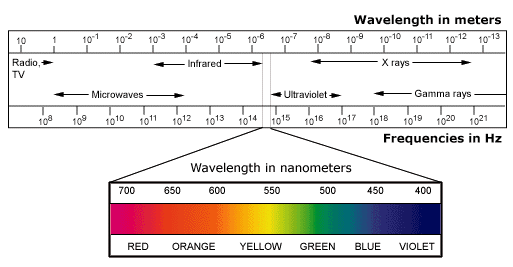
- UV-vis wavelengths promote outer shell electrons
- X-rays promote inner shell e- = much more E
|
|
26
|
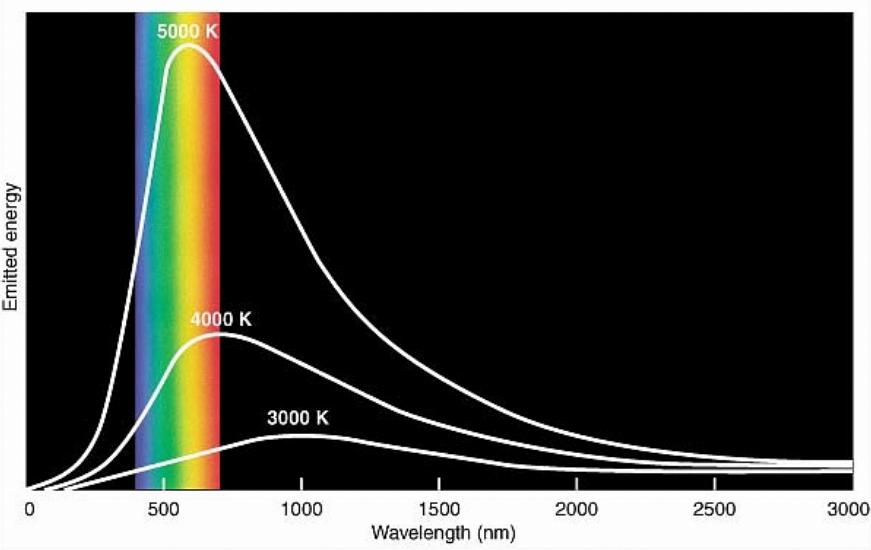
- Spectral Distribution Curves of a Tungsten (Black Body) Absorber/Emitter
|
|
27
|
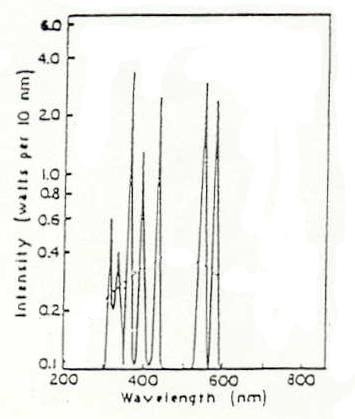
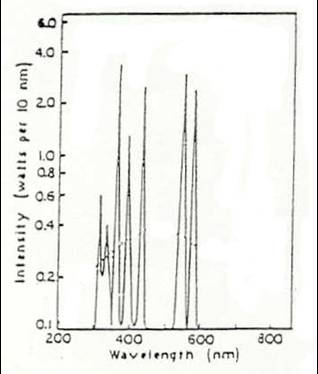
- Line spectrum from
- 100 watt Hydrogen
- Lamp at low
- pressure in Pyrex
|
|
28
|
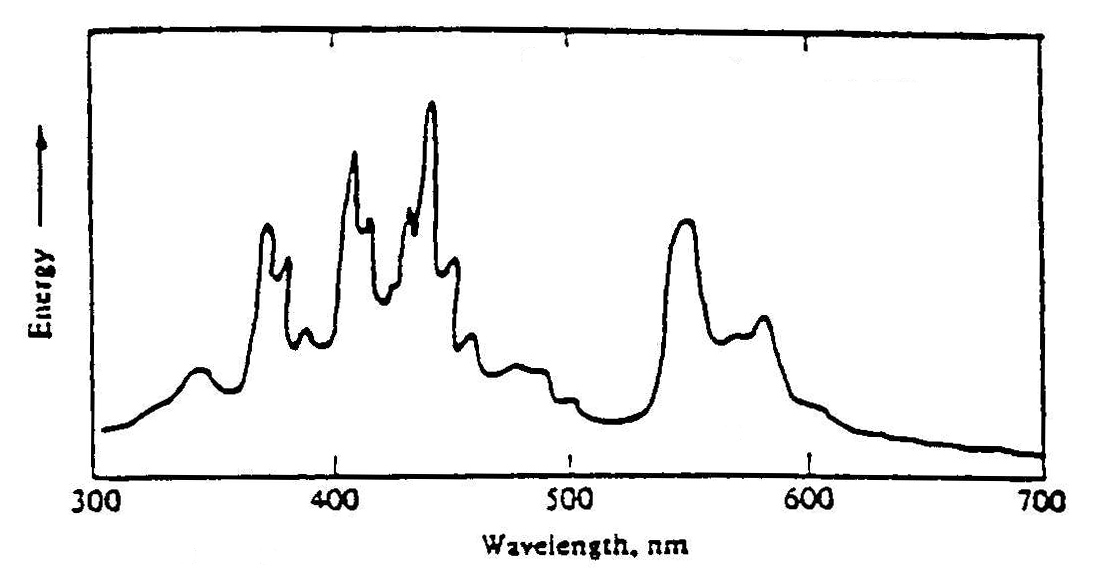
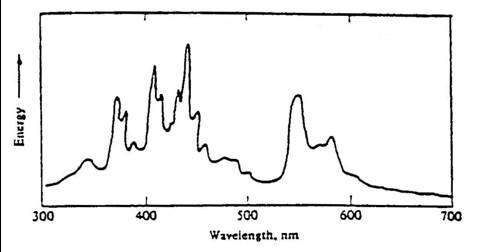
- High Pressure Mercury Spectrum – (e.g., 100 atm)
|
|
29
|
- Theory – The total energy of a molecule can be broken down into several
types of energy
- For UV-vis must consider:
- electronic energy
- vibrational energy
- rotational energy
- Ignore translational energy
- Molecular Absorption – more complex than atomic absorption because
molecules have many more possible transitions
|
|
30
|
- Electronic energy involves changes in energy levels of the outer
electrons of a molecule
- - these changes correspond to the energy of the ultraviolet-visible
radiation
- - these changes are quantized (i.e. discrete levels exist
corresponding to quanta of light)
- DE = DEelec.
+ DEvib. +
DErot.
|
|
31
|
- Simplified Energy Level Diagram
|
|
32
|
- In the IR region of the spectrum the radiation is not energetic enough
to cause electronic transitions
- Even less energetic radiation can be used i.e. microwaves and radio
waves
- Place sample in magnetic field and can observe low energy transitions
associated with changes in spin states e.g. NMR, EPR (ESR)
|
|
33
|
- Once the excited state is formed, it will eventually “relax” or go back
down to the ground state either by:
- Nonradiative relaxation = no light (heat)
- Emission = light emitted that is characteristic of the transition
- Large DE then more energetic
radiation i.e. shorter wavelength UV, x-ray, etc.
- Greater or lesser intensity depending on the number of atoms or
molecules involved in the transition
- Also a probability factor
|
|
34
|
- Beer-Lambert Law (or Beer’s Law)
-
Io
- A =
log ---- = ε b C
-
I
- I
- T =
---- %T =
T x 100
- Io
- Io = measured source intensity
- I = measured intensity after absorption
- Intensity change does not change absorbance
|
|
35
|
- Absorbance & Transmittance are unitless
- If C is mol/L & b is in cm then ε is L/mol-cm
- To minimize the effect of light loses from reflection the procedure
followed in UV-vis spectrophotometry is to measure Io with a
reference blank of pure solvent in the light path & then measure I
under the same conditions – cuvettes should be optically matched if
using 2 & clean, free of scratches, lint, fingerprints, etc.
|
|
36
|
- Effects other than absorption that reduce source intensity (i.e.,
scattering, reflection) may also be measured as absorbance and must be
accounted for when measuring I & Io
|

 Notes
Notes