|
1
|
- General Design of Optical Instruments
- Sources of Radiation
- Wavelength Selectors
- Sample Containers
- Radiation Transducers (Detectors)
- Signal Processors and Readouts
- Fiber Optics
|
|
2
|
- Focus our attention on measurements in the UV-vis region of the EM
spectrum
- Good instrumentation available
- Very widely used techniques
- Longstanding and proven methods
- IR instrumentation will be considered from time to time particularly
when there are similarities to UV-vis
|
|
3
|
- Absorption measurements require:
- 1) source of radiation
- 2) device for dispersing radiation into component wavelengths
- 3) a means of putting sample into the optical path, i.e., cell
- 4) Detector to convert the EM to an electrical signal
- 5) readout device or circuitry, i.e., meter, computer, recorder,
integrator, etc.
|
|
4
|
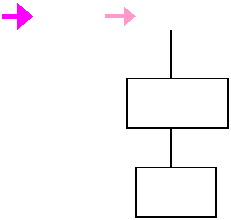
- Block diagram of instrument for
absorption
|
|
5
|
- Block diagram of instrument for
absorption
|
|
6
|
- Emission measurements require:
- 1) means of exciting emission i.e., way of populating upper energy
level which spontaneously emits
- 2) device for dispersing radiation into component wavelengths
- 3) a means of putting sample into the optical path, i.e., cell
- 4) Detector to convert the EM to an electrical signal
- 5) readout device or circuitry, i.e., meter, computer, recorder,
integrator, etc.
|
|
7
|
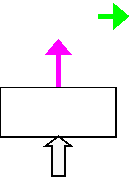
- Block diagram of instrument for
emission i.e.,
-
& fluorescence
-
phosphorescence
|
|
8
|
- The requirements for the various components used in different
instruments change with the type of spectroscopy as well as for
different kinds of measurements within a type of spectroscopy
- We will consider the components separately then combine them to make the
overall instrument
- And finally look at the measurements with regard to theory and practice
|
|
9
|
- Sources – important characteristics
- 1) Spectral distribution i.e., intensity vs. λ
(continuum vs. line sources)
- 2) Intensity
- 3) Stability – short term fluctuations (noise), long term drift
- 4) Cost
- 5) Lifetime
- 6) Geometry – match to dispersion device
|
|
10
|
- CONTINUUM SOURCES
- Thermal radiation (incandescence) – heated solid emits radiation close
to the theoretical “Black Body” radiation i.e., perfect emitter,
perfect absorber
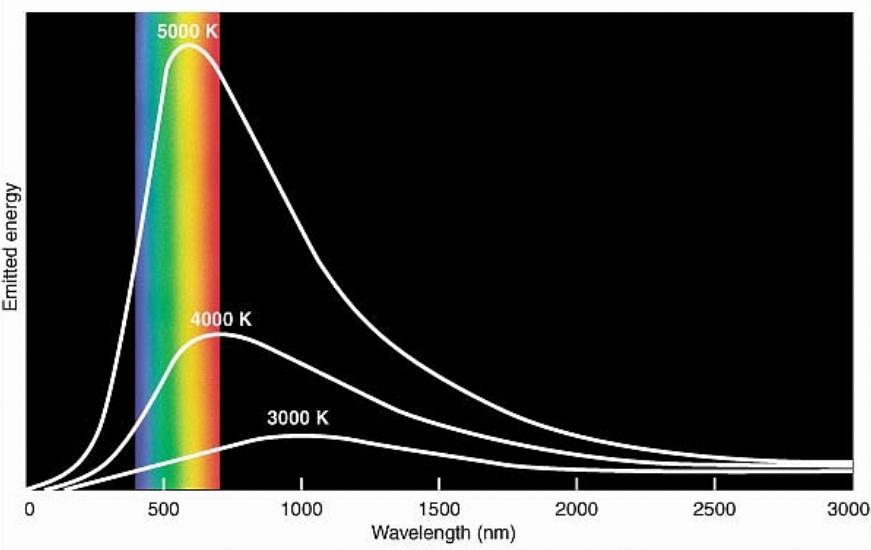
- Behavior of Black Body
- - Total power ~ T4 therefore need constant temperature
for stability when using incandescent sources
- - Spectral distribution follows Planck’s radiation law
|
|
11
|
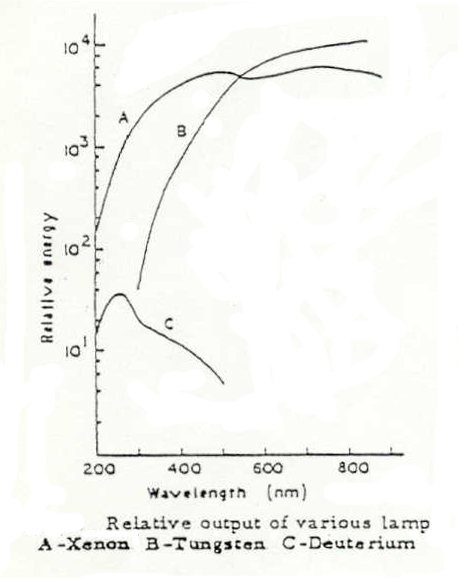
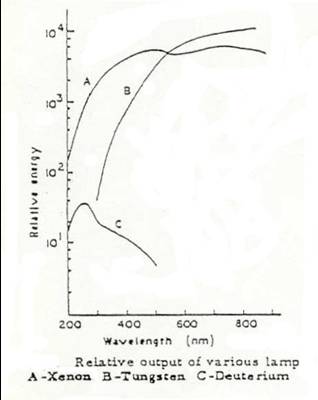
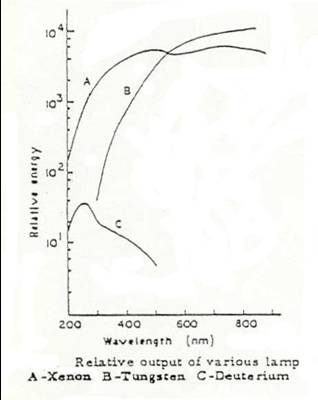
- Spectral Distribution Curves of a Tungsten (Black Body) Lamp
|
|
12
|
- IR Region thermal sources (Black Body) are:
- Nernst Glower – fused mixture of ZrO2, Y2O3,
and ThO2 normally operated at 1900 oC – better for
shorter IR λ’s (near IR)
- Globar – silicon carbide normally operated at 1200 to 1400 oC
– better at longer IR λ’s (doesn’t approach Black Body)
- Incandescent Wire – e.g., nichrome wire – cheapest way
|
|
13
|
- All operated at relatively low temperature.
- Good for IR and give some visible emission.
- Operated in air so will burn up if temp goes too high
- Advantages
- Nernst Glower – low power consumption, operates in air, long lifetime
- Globar – more stable than Nernst Glower, requires more power & must
be cooled. Long lifetime, but
resistance changes with use
|
|
14
|
- Visible Region sources are:
- Glass enclosed Tungsten (W) filament - normally operated at ~3000 oK
with inert atmosphere to prevent oxidation. Useful from 350 nm to 2000 nm, below
350 nm glass envelope absorbs & emission weak
- Tungsten-Halogen lamps - can be operated as high as 3500 oK. More intense (high flux). Function of halogen is to form
volatile tungsten-halide which redeposits W on filament, i.e., keeps
filament from burning out.
Requires quartz envelope to withstand high temps (which also
transmits down to shorter wavelengths).
Fingerprints are a problem – also car headlights
|
|
15
|
- Gas Discharge Lamps – two electrodes with a current between them in a
gas filled tube. Excitation
results from electrons moving through gas. Electrons collide with gas à excitation à emission
- At high pressure à “smearing”
of energy levels à
spectrum approaches continuum
- The higher the pressure, the greater the probability that any given
molecule or atom will be perturbed by its neighbor at the moment of
emission.
|
|
16
|
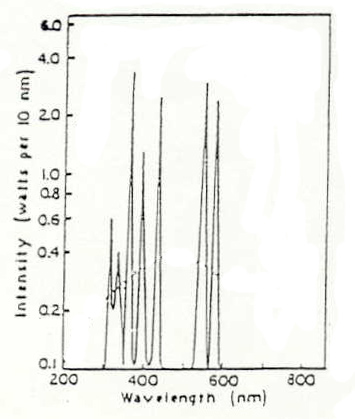
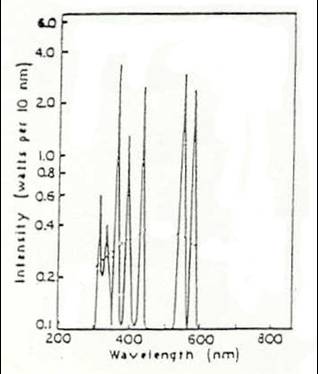
- Hydrogen Lamp - most common source for UV absorption measurements
- H2 emission is from
- 180 nm to 370 nm
- limited by jacket
- Line spectrum from à
- 100 watt Hydrogen
- Lamp at low pressure in
- Pyrex
|
|
17
|
- Deuterium Lamp – same λ distribution as H2 but with
higher intensity (3 to 5 times) -
- D2 is a heavier
- molecule & moves
- slower so there is
- less loss of energy
- by collisions
- High pressure D2 à
- with quartz jacket
|
|
18
|
- For higher intensity
- Xenon Lamp – Xe at high pressure (10-20 atm)
- - high pressure needed
- to get lots of collisions
- for broadening
- leading to continuum
- - short life relatively
- - arc wander (stabilize)
- - need jolt to start
- - output = f(time)
|
|
19
|
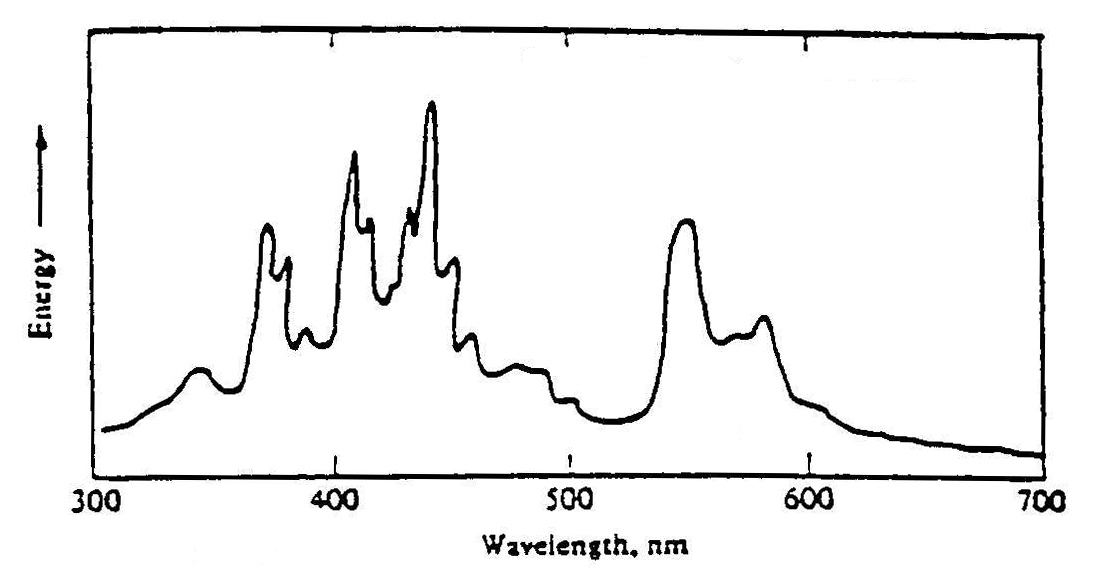
- d) High Pressure Mercury Lamp – can’t completely eliminate bands
associated with particular electronic transitions even at very high
pressures (e.g., 100 atm)
|
|
20
|
- For UV-vis absorption spectrophotometry usually use H2 for UV
and tungsten for visible region (switching mid scan)
- Sometimes use D2 instead of H2
- For fluorescence spectrophotometry use xenon arc lamp in scanning
instruments
- Can use He below 200 nm
- Hg at low pressure is used in fixed wavelength (non scanning)
fluorometers
- Can use mixture of Hg and Xe
|
|
21
|
- LINE SOURCES
- Gas (Vapor) Discharge Lamps at low pressure (i.e., few torr) – minimize
collisional interaction so get line spectrum
- - most common are Hg and Na
- - often used for λ calibration
- - Hg pen lamp
- - fluorescent lights are another example
- - also used UV detectors for HPLC
- Hollow Cathode Lamps (HCL) – for AA
- Electrodeless Discharge Lamps (EDL) - AA
|
|
22
|
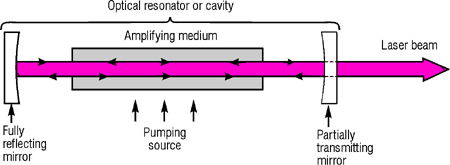
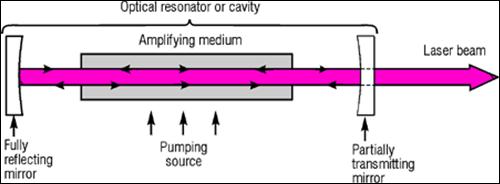
- 4) Lasers (Light Amplification by Stimulated Emission of Radiation) –
start with material that will exhibit stimulated emission and populate
upper states typically using another light source
|
|
23
|
- Stimulated Emission – photon strikes excited state causing it to emit a
burst of photons
- Pumping source used to populate upper states can be flashlamp, another
laser or electrical
- Often use prism to select pumping wavelength
- Advantages of lasers
- 1) Intense
- 2) Monochromatic – very narrow band
- 3) Coherent – all radiation at same phase
- angle
|
|
24
|
- 4) Directional – full intensity emitted as beam
- Limitations of lasers
- High cost in many cases
- Wavelength range is somewhat limited
- Many operate in pulsed mode – some are continuous wave (CW)
- Pulsed mode lasers are not always problematic as light sources, can use
pulse frequency with gated detection
|
|
25
|
- Types of Lasers:
- 1) Solid State Lasers
- a) Ruby laser – Al2O3 + Cr(III) - 694.3 nm
pumped with Xe arc flashlamp – pulsed (can be continuous)
- b) Nd/YAG laser – yittrium aluminum garnet + Nd - 1064 nm
- 2) Gas Lasers
- a) Neutral atom – He-Ne – 632.8 nm continuous
- b) Ion lasers – Ar+ or Kr+ 514.5 nm
|
|
26
|
- c) Molecular lasers – CO2 (10,000 nm = 1000 cm-1)
or N2 (337.1 nm) pulsed
- d) Eximer lasers – inert gas + fluorine creates eximers ArF+ (193
nm), KrF+ (248 nm), XeF+ (351) pulsed
- Dye Lasers – tunable over 20 – 50 nm many dyes available for wide range
of λ’s
- Semiconductor Diode Lasers – wide range of λ’s available,
continuous
|
|
27
|
- Three main approaches:
- 1) Block off unwanted radiation – optical filters
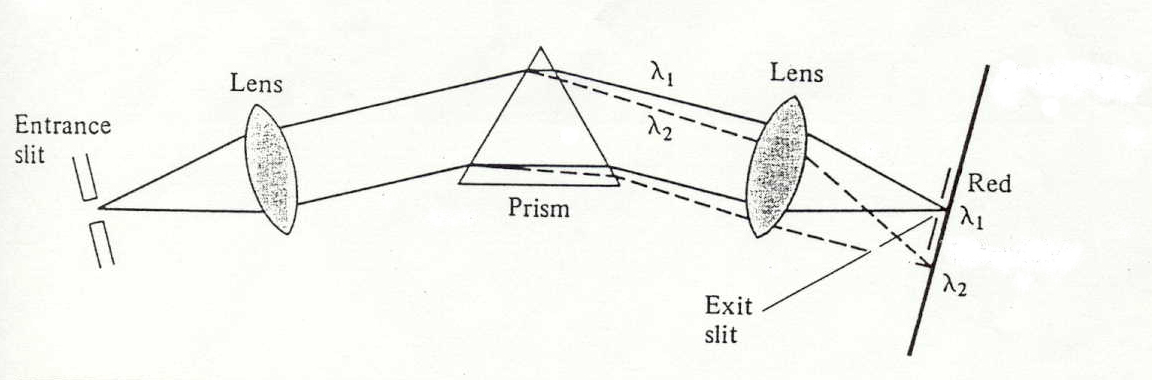
- 2) Disperse radiation & select desired band – monochromator
- 3) Modulate wavelengths at different frequencies - interferometer
- FILTERS
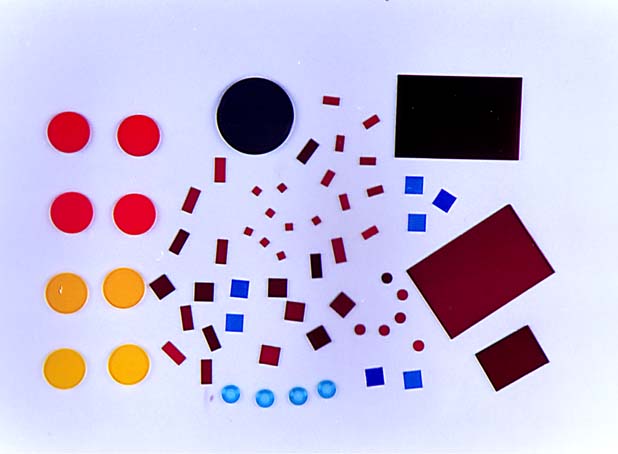
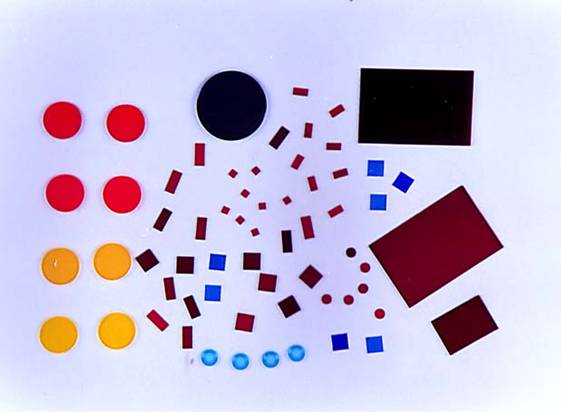
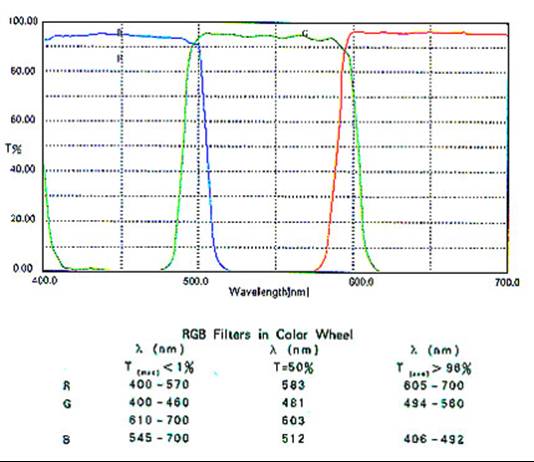
- 1) Absorption – colored glass, colored film, colored solutions –
cheapest way
|
|
28
|
|
|
29
|
|
|
30
|
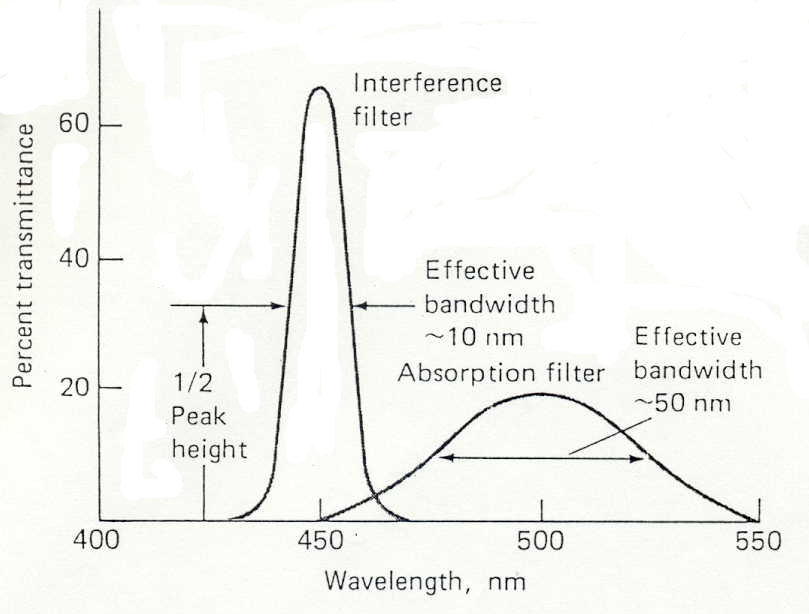
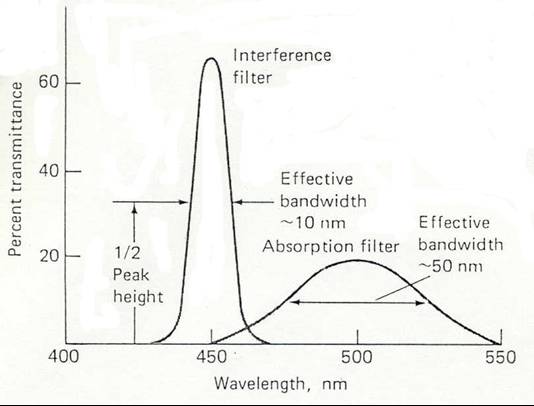
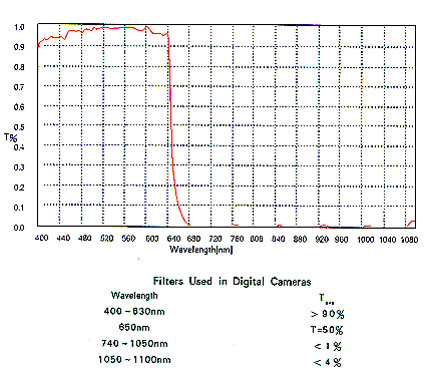
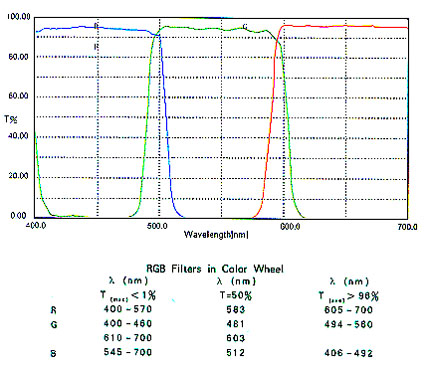
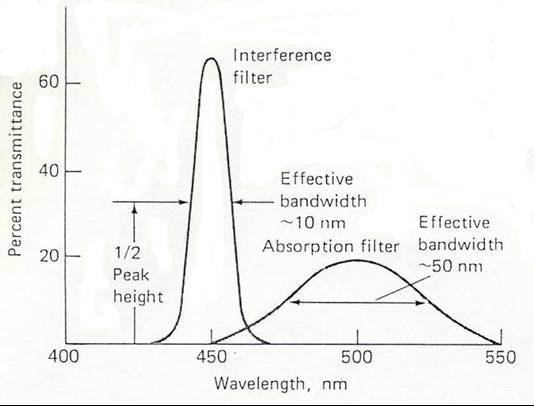
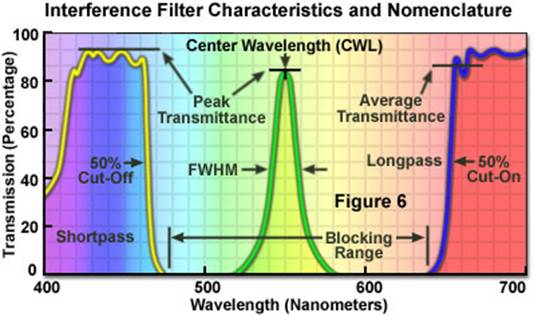
- Absorption filters are also known as bandpass filters
- Usually exhibit low peak transmittance
- Typically have a broad peak profile
- Can use two or more absorption filters together to produce desired
transmittance characteristics
- Generic filters are 2 x 2 inch glass or quartz
- Relatively inexpensive
|
|
31
|
|
|
32
|
|
|
33
|
|
|
34
|
|
|
35
|
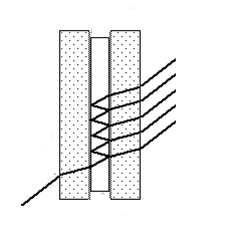
- Condition for constructive interference
-
mλ
- 2d =
------
-
η
- If distance (d) is multiple (m) of wavelength (λ) then it won’t be
interfered with
- Concept of Order – constructive & destructive interference causes
waves with different phase angles to be eliminated except if they are
multiples of each other
|
|
36
|
|
|
37
|
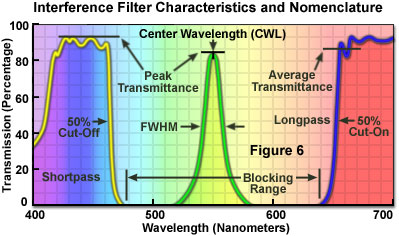
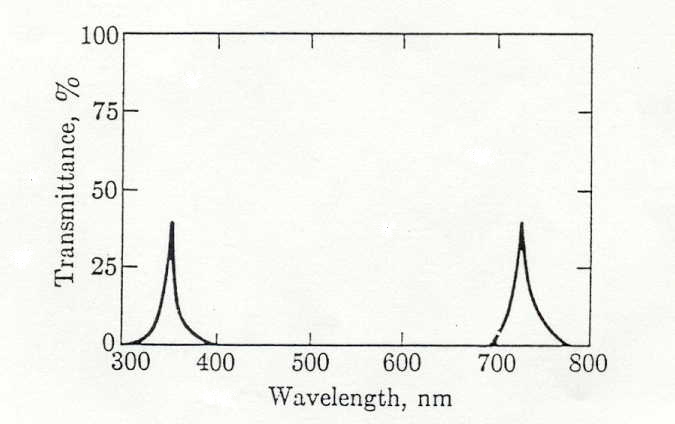
- Transmittance vs. wavelength for typical Fabrey-Perot Interference
filter showing first and second order λ’s (m = 1 & m = 2)
|
|
38
|
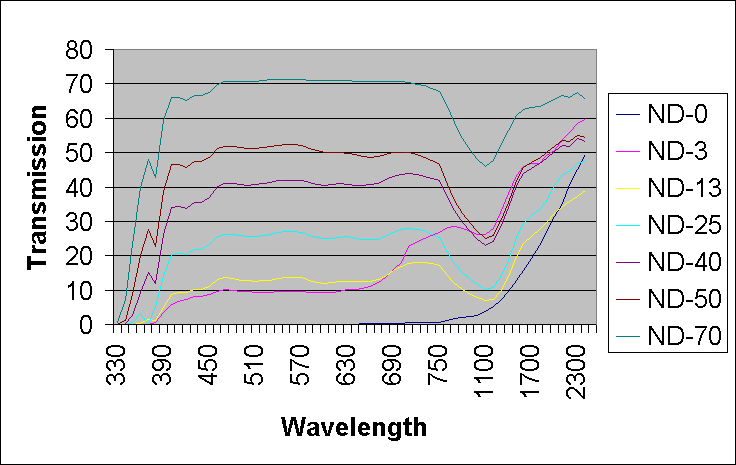
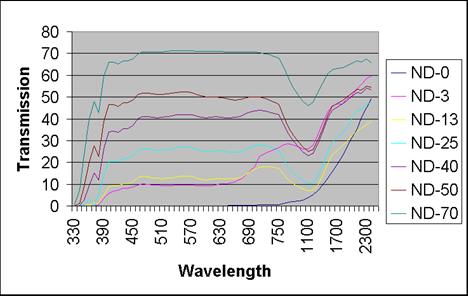
- 3) Neutral density filters – reduces intensity without any λ
discrimination
|
|
39
|
|
|
40
|
- Optical Materials – need optically transparent materials for lenses,
prisms & sample cells
- In visible region – can use glass down to 350 nm
- In the UV region – quartz is material of choice
- In the IR region – NaCl, KBr, etc. The heavier the atoms of the salt,
the farther into the IR region (i.e., longer λ) before significant
absorption occurs
- Problem – sensitivity to moisture
|

 Notes
Notes