|
In the century since Pavesich was
decided, "The Right to Privacy" has been widely recognized
as the most influential law review article in American
history. While it would be impossible to summarize
here even a portion of the commentary, criticism, and praise
that have been heaped on Brandeis and Warren's essay over
the past eleven decades, the evidence presented in the
preceding pages allows us to draw three conclusions about
its contribution to the configuration of the public/private
split in American legal and social thought:
-
First, the
perspective adopted in "The Right to Privacy" was
highly interventionist, however much that fact has
been buried in references to "the right to be let
alone." Judges and other public officials in
Brandeis and Warren's day may have chosen to look
the other way in cases of sexual assault and
household violence, but the entire purpose of "The
Right to Privacy" was to extend the reach of the
legal system so that men would not have to fend for
themselves in avenging injuries to their feelings
and reputations.
-
Second, as
evidenced in Brandeis and Warren's approval of legal
fictions to guard against the disclosure of sexual
crimes, as well as their perception of newspaper
gossip as a blight on common decency, "The Right to
Privacy" can be most accurately described, not as a
call for the state to step back from the private
sphere, but as an approach to public discourse that
upheld the threat of litigation as a means to
encourage the press and other people to practice
self-censorship.
-
Third, the
contrast between Brandeis and Warren's appeals to
tradition and history and first-wave feminist calls
for a transformation of both the public and private
spheres shows that "The Right to Privacy" can be
better understood as an effort to cement social
conformity than as a defense of individual freedom.

More generally, setting "The Right
to Privacy" against the backdrop of the cult of domesticity
in the late nineteenth century allows us to understand more
clearly how the public/private dichotomy unfolded in later
years. The historical forces that fomented
twentieth-century concerns about privacy are far too complex
to capture in a few paragraphs. It is, however,
obvious that Brandeis and Warren's views on the sanctity of
the home took hold in part because they dovetailed so
seamlessly with the privatizing tendencies of industrial
capitalism. Although its authors railed against the
vulgar exhibitionism of commercial culture, "The Right
to Privacy" confirmed the commercial messages that were
quickly becoming ubiquitous in American life. The idea
that every man's home is his castle is, after all,
exceedingly familiar, not because lawyers like to quote Lord
Coke, but because it has been so tirelessly repeated in so
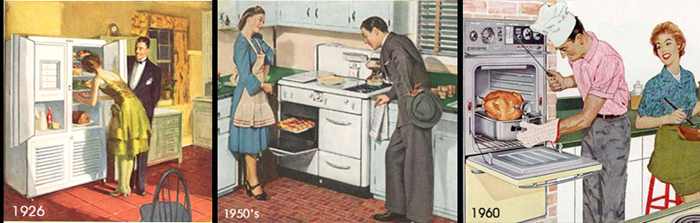
many forms by the advertising industry. Indeed, if
there was one directive that middle-class Americans received
more often than any other during the twentieth century, it
was that the greatest joys and pleasures can be had within
the properly furnished, smartly equipped, tastefully
decorated, fully secured, and well-stocked private home. 52s
However much Brandeis
and Warren may have wished to shield the home from
commercial modernity, the cult of domesticity was
and still remains a mother lode for American business.
Construction companies such as Aladdin, which offered
every man his own readymade "Castle" for under $500 in
1909, flourished by helping to install homeownership as
a standard component of the American dream. Slews of
others prospered by pointing out the breathtaking
wonders that right-minded people enjoy within safety,
comfort, and, above all, privacy of their homes.53s
Elevating popular preoccupation with domestic relations
to new heights, advertisements for appliances,
furniture, clothing, decorative objects, and other
must-have merchandise reinforced Brandeis and Warren's
vision of the home as the place where individuals find
self-fulfillment within the bosom of their families.
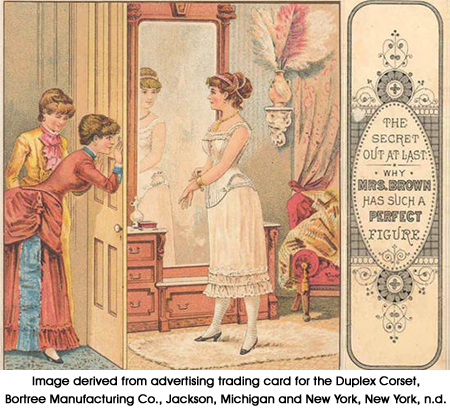
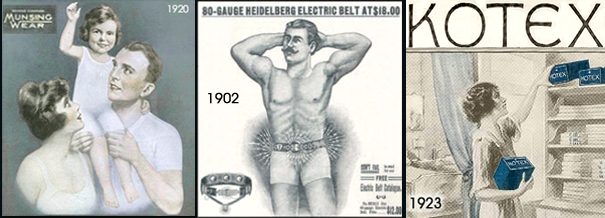
Paradoxically, however, the advertisers conveyed this
message mainly by placing private life on display,
flooding American culture with images of intimacy, and
turning previously unmentionable topics such as ladies'
underwear and male impotence into subjects of social
discourse. 54s
The avalanche of ads that paid
tribute to the joys of domesticity boosted the value of
privacy both as an economic selling point and as a
social ideal. At the same time, the
commercialization of the private realm made the notion
of the home as a haven increasingly hard to sustain.
After all, the telephone, radio, television, and, most
recently, the Internet, blurred the boundaries between
public and private, not simply by bringing outside
forces directly into the domestic circle, but, more
specifically, by filling it with anxiety-inducing
messages about the need for additional spending.
Thus, in the course of the twentieth century, as the
line between the marketplace and the home dissolved in a
barrage of commercial exhortation, and consumerism
became an organizing principle, if not the lifeblood, of
the average American family, economic expansion
conspired with possessive individualism to make the home
seem more like an incomplete collection of commodities
than a refuge from the outside world. Indeed, in
view of the nearly identical houses crammed with nearly
identical objects that currently crowd the American
landscape, it seems more realistic to define the
American home as an involuntary response to market
forces than as a shelter from extrinsic pressures,
expectations, and trends.
The popular conception of the home
as a refuge is misguided, not only because it belies the
extent to which commercial forces have shaped the private
sphere, but also because it implies that we are somehow more
free behind closed doors than we are on a public highway.
However, in spite of all we've been told about which
products will allow us to kick back, relax, and be ourselves
in private spaces, it is hard to find any instance in which
we could realize significantly greater freedom by shutting
ourselves off from the wider world. In fact, apart
from being able to expose more of our bodies, which is the
governing principle behind prohibitions against publicly
performing or describing certain bodily functions and sexual
acts, we have no more liberty in private than we do in
public.55s Not
only must we obey almost all the same laws on both sides of
the public/private divide, but it would certainly be a
stretch to imagine that we may somehow evade social
expectations, moral strictures, and ethical considerations
simply by drawing the shades.56s

Without denying the relief that
may come from avoiding public scrutiny, we can see how the definition
of the private realm as an area in which human beings may
operate with some greater degree of autonomy has muddied our
comprehension of the issues most closely tied to the right
to privacy. Abortion is, for example, not more or less
private than brain surgery. Like other types of
medical treatment, it is subject to public regulation and
can only be carried out with the assistance of people who
are licensed and supervised by the state.57s
Likewise, it has become less dangerous to engage in
homosexual activity, not because this behavior is now
located in the private realm, but because it has been
decriminalized.58s
Indeed, it makes more sense in the cases of abortion and
homosexual sodomy to recognize that these activities have
always taken place in private, and it was only public
intervention, mainly in the form of grassroots activism and
legal rulings, that enabled at least some individuals to
access abortion services or to engage in homosexual
relationships without having to fear retribution from either
private actors or the government.
It is, moreover, helpful to
remember that the space originally defended in "The Right to
Privacy" and later defined, however vaguely, as deserving of
legal protection was not the home or the family as a lived
reality, but an idealized and largely commercialized vision
of domesticity. As a result, the "zone of privacy"
that was mapped out hazily in court rulings and in
legislation passed throughout the twentieth century has, for
the most part, been legitimized only to the extent that it
seemed to conform to accepted notions about the normal
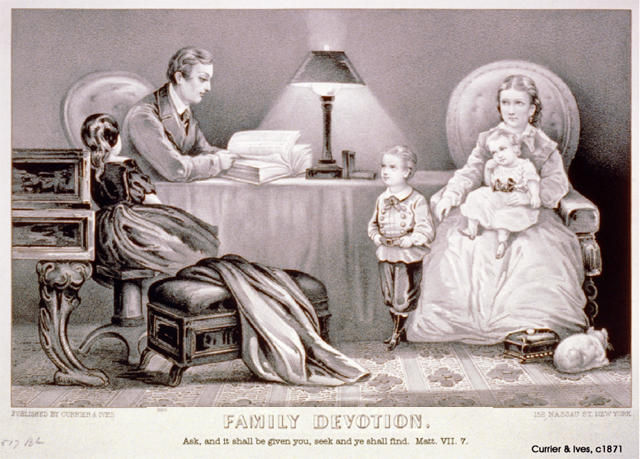
bourgeois family. It is, for example, no accident that
William O. Douglas's tribute to marriage in Griswold
v. Connecticut so
closely resembles the sentimental images of domestic order
that have permeated American culture since the heyday of
Currier & Ives:
We
deal with a right of privacy older than the Bill of
Rights - older than our political parties, older
than our school system. Marriage is a coming
together for better or for worse, hopefully
enduring, and intimate to the degree of being
sacred. It is an association that promotes a way of
life, not causes; a harmony in living, not political
faiths; a bilateral loyalty, not commercial or
social projects. Yet it is an association for as
noble a purpose as any involved in our prior
decisions. 21p

Without dismissing the appeal of
these sentiments--or denying that the traditional dream of
domesticity has lately been pervaded by same-sex couples--it
is interesting to note that Douglas offered this salutation
to marriage during an era when radical and even
not-so-radical feminists were echoing Woodhull and Gilman's
critique of the bourgeois family as an enervating cage.59s
Douglas's concept of "bilateral loyalty" may be viewed step
ahead of the paternalistic approach to domestic relations
taken in "The Right to Privacy." Nonetheless, his
commentary on the sanctity of marriage harkens back to
Brandeis and Warren's efforts to situate moral reality
inside the apolitical confines of the ostensibly happy home.
In this respect, Griswold mimicked
Brandeis and Warren's response to the nineteenth-century
struggle for women's rights. As we have seen, they
responded to the women's movement, as well as the
technological transformations of their time, by trying to
carve out an area of life that would remain untouched by
commercial pressures, social ambitions, and political
disputes. Similarly, at a moment when feminists
shouting, "The personal is political!" had just begun to
gather in public demonstrations, Douglas asserted the right
to privacy as a means to separate the domestic realm from
the social, commercial, and political "projects" that
preoccupied the world outside the family. 60s
The poetic commentary contained in
the Griswold decision
allows us to see that Brandeis's contribution to the
elevation of the right to privacy in American legal culture
cannot be coherently tied to libertarianism or to a
philosophy of limited government. Instead, as shown in
Brandeis's approach to government regulation both before and
during his tenure on the Supreme Court, his definition of
privacy as the premier value of civilized society translated
into a sometimes highly intrusive dedication to calling on
government to guarantee the priority of the family over
everything else. For example, in his famous
brief in Muller
v. Oregon (1908),
Brandeis marshaled social statistics to show that the
biological destiny of women as wives and mothers supersedes
their rights as individuals. Advancing the same
protectionist approach that he and Warren had adopted in
"The Right to Privacy," Brandeis maintained that women
needed to be secured from economic exploitation so that they
could properly discharge their natural familial obligations.
His brief was accordingly designed, not to promote the well
being of workers in general, but to legitimize gender
discrimination by forcing employers to take heed of the
duties and disadvantages attached to womanhood. Just as the
Court in earlier cases had
singled out women's bodies as deserving of special
protections, Justice Brewer drew on Brandeis's work to argue
that the physical drawbacks of being female, as well as the
burdens of maternity, legitimized treating "woman as an
object of public interest and care." In other words,
even though there might at first glance seem to be some
inconsistency between Brandeis's exaltation of privacy and
his case for government regulation of female labor, both
were interventionist efforts to safeguard family relations,
and both endeavored to achieve that goal mainly by shielding
the female body, in Brewer's words, "from the greed and
passion of man." 13p
The paradoxes that have arisen in
the historical trajectory set off in "The Right to Privacy"
make sense when we consider their starting point.
Writing in reaction to rapid social change, Brandeis and
Warren's main objective was to discover legal instruments
that would enable men to preserve their masculinity by
screening themselves and their dependents from the ever more
intrusive pressures of late nineteenth-century industrial
society. True to the progressive spirit of their age,
as well as their conservative commitment to domestic
tranquility, they found in the common law precisely the
right tool to allow modern man to carry out this ancient
prerogative, "a
weapon...forged in the slow fire of the centuries, and
to-day fitly tempered to his hand." 2p In
line with these chivalrous sentiments, and in keeping with
the valorization of the domestic sphere in subsequent
decades, the lasting legacy of "The Right to Privacy" has
been not to enlarge individual liberty, but to outline a
legally sanctioned and socially acceptable context in which
men and women could meet their moral obligations by
conforming or, at least, seeming to conform to conventional
family roles.
|