|
Plato & Aristotle: A Few Basic Concepts |
||||||||||||
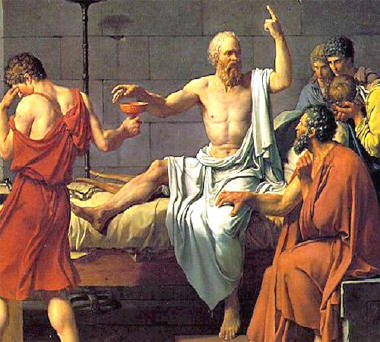
Socrates (469-399 B.C.E.) Source = http://www.philosophypages.com/ph/socr.htmAristotle's Political TheoryAristotle (b. 384 - d. 322 BC), was a Greek philosopher, logician, and scientist. Along with his teacher Plato, Aristotle is generally regarded as one of the most influential ancient thinkers in a number of philosophical fields, including political theory. Aristotle was born in Stagira in northern Greece, and his father was a court physician to the king of Macedon. As a young man he studied in Plato's Academy in Athens. After Plato's death he left Athens to conduct philosophical and biological research in Asia Minor and Lesbos, and he was then invited by King Philip II of Macedon to tutor his young son, Alexander the Great. Soon after Alexander succeeded his father, consolidated the conquest of the Greek city-states, and launched the invasion of the Persian Empire. Aristotle returned as a resident alien to Athens, and was close friend of Antipater the Macedonian viceroy. At this time (335-323 BC) he wrote or at least completed some of his major treatises, including the Politics. When Alexander died suddenly, Aristotle had to flee from Athens because of his Macedonian connections, and he died soon after. Aristotle's life seems to have influenced his political thought in various ways: his interest in biology seems to be expressed in the naturalism of his politics; his interest in comparative politics and his sympathies for democracy as well as monarchy may have been encouraged by his travels and experience of diverse political systems; he criticizes harshly, while borrowing extensively, from Plato's Republic, Statesman, and Laws; and his own Politics is intended to guide rulers and statesmen, reflecting the high political circles in which he moved. 1. Political Science in GeneralThe modern word ‘political’ derives from the Greek politikos, ‘of, or pertaining to, the polis’. (The Greek term polis will be translated here as ‘city-state’. It is also translated as ‘city’ or ‘polis’, or simply anglicized as ‘polis’. City-states like Athens and Sparta were relatively small and cohesive units, in which political, religious, and cultural concerns were intertwined. The extent of their similarity to modern nation-states is controversial.) Aristotle's word for ‘politics’ is politikê, which is short for politikê epistêmê or ‘political science’. It belongs to one of the three main branches of science, which Aristotle distinguishes by their ends or objects. Contemplative science (including physics and metaphysics) is concerned with truth or knowledge for its own sake; practical science with good action; and productive science with making useful or beautiful objects (Top. VI.6.145a14-16, Met. VI.1.1025b24, XI.7.1064a16-19, EN VI.2.1139a26-8). Politics is a practical science, since it is concerned with the noble action or happiness of the citizens (although it resembles a productive science in that it seeks to create, preserve, and reform political systems.) Aristotle thus understands politics as a normative or prescriptive discipline rather than as a purely empirical or descriptive inquiry...
[According to Aristotle,]
Soon after, he states that the city-state comes into being for the sake of life but exists for the sake of the good life (2.1252b29-30). The theme that the good life or happiness is the proper end of the city-state recurs throughout the Politics (III.6.1278b17-24, 9.1280b39; VII.2.1325a7-10). 3. General Theory of Constitutions and CitizenshipAristotle states that "the politician and lawgiver is wholly occupied with the city-state, and the constitution is a certain way of organizing those who inhabit the city-state" (III.1.1274b36-8). His general theory of constitutions is set forth in Politics III. He begins with a definition of the citizen (politês), since the city-state is by nature a collective entity, a multitude of citizens. Citizens are distinguished from other inhabitants, such as resident aliens and slaves; and even children and seniors are not unqualified citizens (nor are most ordinary workers). After further analysis he defines the citizen as a person who has the right (exousia) to participate in deliberative or judicial office (1275b18-21). In Athens, for example, citizens had the right to attend the assembly, the council, and other bodies, or to sit on juries. The Athenian system differed from a modern representative democracy in that the citizens were more directly involved in governing. Although full citizenship tended to be restricted in the Greek city-states (with women, slaves, foreigners, and some others excluded), the citizens were more deeply enfranchised than in modern representative democracies because they were more directly involved in governing. This is reflected in Aristotle's definition of the citizen (without qualification). Further, he defines the city-state (in the unqualified sense) as a multitude of such citizens which is adequate for a self-sufficient life (1275b20-21). Aristotle defines the constitution as a way of organizing the offices of the city-state, particularly the sovereign office (III.6.1278b8-10; cf. IV.1.1289a15-18). The constitution thus defines the governing body, which takes different forms: for example, in a democracy it is the people, and in an oligarchy it is a select few (the wealthy or well born). Before attempting to distinguish and evaluate various constitutions Aristotle considers two questions. First, why does a city-state come into being? He recalls the thesis, defended in Politics I.2, that human beings are by nature political animals, who naturally want to live together. For a further discussion of this topic, see the following supplementary document: He then adds that "the common advantage also brings them together insofar as they each attain the noble life. This is above all the end for all both in common and separately." (III.6.1278b19-24) Second, what are the different forms of rule by which one individual or group can rule over another? Aristotle distinguishes several types. He first considers despotic rule, which is exemplified in the master-slave relationship. Aristotle thinks that this form of rule is justified in the case of natural slaves who (he asserts without evidence) lack a deliberative faculty and thus need a natural master to direct them (I.13.1260a12; slavery is defended at length in Politics I.4-8). Although a natural slave allegedly benefits from having a master, despotic rule is still primarily for the sake of the master and only incidentally for the slave (III.6.1278b32-7). (Aristotle provides no argument for this: if some persons are congenitally incapable of self-governance, why should they not be ruled primarily for their own sakes?) He next considers paternal and marital rule, which he also views as defensible: "the male is by nature more capable of leadership than the female, unless he is constituted in some way contrary to nature, and the elder and perfect [is by nature more capable of leadership] than the younger and imperfect." (I.12.1259a39-b4) Aristotle is persuasive when he argues that children need adult supervision because their rationality is "imperfect" (ateles) or immature. But he also alleges (without substantiation) that, although women have a deliberative faculty, it is "without authority" (akuron), so that females require male leadership (I.13.1260a13-14). (Aristotle's arguments about slaves and women appear so weak that some commentators take them to be ironic. However, what is obvious to a modern reader need not have been so to an ancient Greek, so that it is not necessary to suppose that Aristotle's discussion is ironic.) It is noteworthy, however, that paternal and marital rule are properly practiced for the sake of the ruled (for the sake of the child and of the wife respectively), just as arts like medicine or gymnastics are practiced for the sake of the patient (III.6.1278b37-1279a1). In this respect they resemble political rule, which involves equal and similar citizens taking turns in ruling for one another's advantage (1279a8-13). This sets the stage for the fundamental claim of Aristotle's constitutional theory: "constitutions which aim at the common advantage are correct and just without qualification, whereas those which aim only at the advantage of the rulers are deviant and unjust, because they involve despotic rule which is inappropriate for a community of free persons" (1279a17-21). The distinction between correct and deviant constitutions is combined with the observation that the government may consist of one person, a few, or a multitude. Hence, there are six possible constitutional forms (Politics I.7):
This six-fold classification (which is adapted from Plato's Statesman) sets the stage for Aristotle's inquiry into the best constitution, although it is modified in various ways throughout the Politics. For example, he observes that the dominant class in oligarchy (literally rule of the oligoi, i.e., few) is typically the wealthy, whereas in democracy (literally rule of the dêmos, i.e., people) it is the poor, so that these economic classes should be included in the definition of these forms (see Politics III.8, IV.4, and VI.2 for alternative accounts). Also, polity is later characterized as a kind of "mixed" constitution typified by rule of the "middle" group of citizens, a moderately wealthy class between the rich and poor (Politics IV.11). Aristotle turns to arguments for and against the different constitutions, which he views as different applications of the principle of distributive justice (III.9.1280a7-22). Everyone agrees, he says, that justice involves treating equal persons equally, and treating unequal persons unequally, but they do not agree on the standard by which individuals are deemed to be equally (or unequally) meritorious or deserving. He assumes his own analysis of distributive justice set forth in Nicomachean Ethics V.3: Justice requires that benefits be distributed to individuals in proportion to their merit or desert. The oligarchs mistakenly think that those who are superior in wealth should also have superior political rights, whereas the democrats hold that those who are equal in free birth should also have equal political rights. Both of these conceptions of political justice are mistaken in Aristotle's view, because they assume a false conception of the ultimate end of the city-state. The city-state is neither a business association to maximize wealth (as the oligarchs suppose) nor an agency to promote liberty and equality (as the democrats maintain). Instead, Aristotle argues, "the good life is the end of the city-state," that is, a life consisting of noble actions (1280b39-1281a4). Hence, the correct conception of justice is aristocratic, assigning political rights to those who make a full contribution to the political community, that is, to those with virtue as well as property and freedom (1281a4-8). This is what Aristotle understands by an "aristocratic" constitution: literally, the rule of the aristoi, i.e., best persons. Aristotle explores the implications of this argument in the remainder of Politics III, considering the rival claims of the rule of law and the rule of a supremely virtuous individual. Here absolute kingship is a limiting case of aristocracy. Again, in books VII-VIII, Aristotle describes the ideal constitution in which the citizens are fully virtuous. Source = http://plato.stanford.edu/entries/aristotle-politics/
|