![dist[a1_, b1_, a2_, b2_] := ((a1 - a2)^2 + (b1 - b2)^2)^(1/2)](HTMLFiles/a01_1.gif)
prepared by Ken Levasseur
![dist[-3, 2, 5, 1]](HTMLFiles/a01_2.gif)

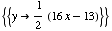
![Solve[dist[x, y, -3, 2] == dist[x, y, 5, 1], y]](HTMLFiles/a01_4.gif)

![Solve[dist[x, y, -3, 2] + dist[x, y, 5, 1] == 9, y]](HTMLFiles/a01_7.gif)

Here is how to plot an output from Solve. First shut off the message that comes up when a complex solution occurs in the plotting.
![Off[Plot :: plnr]](HTMLFiles/a01_9.gif)
Solutions are lists of rules and there are two solutions to this equation.
![solution = Solve[dist[x, y, -3, 2] + dist[x, y, 5, 1] == 9, y]](HTMLFiles/a01_10.gif)

The plot range,  took some adjusting. The AspectRatio option forces a uniform scale on the plot. Otherwise the plot is distorted.
![Plot[Evaluate[y /. solution], {x, -5, 8}, Epilog -> {Point[{-3, 2}], Point[{5, 1}]}, AspectRatio -> Automatic, PlotPoints -> 200]](HTMLFiles/a01_13.gif)
![[Graphics:HTMLFiles/a01_14.gif]](HTMLFiles/a01_14.gif)

Converted by Mathematica (April 17, 2003)