
|
|
|
The properties of liquids and solids depend greatly on how the individual molecules, ions or atoms are attracted to each other. Since ionic solids consist of an extended array of ions bonded together by ionic bonds, they are usually not considered to be molecules or to exist as molecular units. Properties such as melting point, boiling point and heat of fusion or vaporization will all be influenced by the strength of the intermolecular forces. Liquids and Solids
Link to Powerpoint Slides
Intermolecular Forces- These are the forces of attraction between molecules. They are usually relatively weak when compared to the strength of covalent bonds within the molecule.
London dispersion forces- these exist in all molecules and atoms. They result from temporary distortion of the electron distribution of a molecule or atom. The temporary dipole causes an induced dipole in a neighboring molecule or ion, and a weak attraction results. The strength of the attraction is related to the polarizability of the electron cloud surrounding the nuclei. Atoms or molecules with a large number of electrons are more polarizable, and are therefore more likely to distort.
dipole-dipole interactions - these exist in molecules with a permanent dipole. The slightly positively charged end of one molecule is attracted to the slightly negative end of another molecule. These forces can be stronger than London dispersion forces in smaller molecules. They can be roughly equal to 1% of the strength of a typical covalent bond.
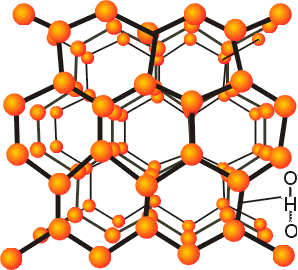
hydrogen bonding - this is an especially strong type of attraction which occurs in molecules with O-H, F-H and N-H bonds. The hydrogen is attached to a small highly electronegative element. It forms a strong attachment (hydrogen bond) with the lone pairs of electrons on the O, N or F atom of an adjacent or nearby molecule. Water has unusually strong hydrogen bonding because each molecule has two relatively positive hydrogens, as well as two lone pairs of electrons, which can donate electron density to the hydrogen of nearby water molecules. The effect of hydrogen bonding on the properties of substances can been seen in the boiling points of compounds containing H-N, H-F or H-O bonds in comparison with comparable compounds containing other elements in their group. The compounds which exhibit hydrogen bonding show extremely high boiling points. Methane, which does not have the capability to undergo hydrogen bonding, shows the expected (low) boiling point.
The strong directional nature of hydrogen bonding causes water to freeze in a "honey comb" type arrangement, with lots of empty space between the molecules. It is for this reason that ice floats, rather than sinks.
Properties of Liquids
surface tension - the resistance of a liquid to increase its surface area. Surface tension is greater for liquids with stronger intermolecular forces.
capillary action - the spontaneous rising of a liquid in a narrow tube. Two forces are involved: cohesive forces ( the forces within the liquid) and adhesive forces (the forces between the liquid and the tube material).
viscosity - a measure of a liquid's resistance to flow.
Liquids are characterized by their equilibrium vapor pressure. This is the pressure exerted over the liquid, in a sealed container, at a specific temperature. Vapor pressure increases with temperature, until the vapor pressure equals atmospheric pressure. The temperature at which this happens is defined as the boiling point of the substance. If the vapor pressure of a liquids is measured at several temperatures, a graph of the ln of P versus 1/T gives a straight line with a slope of -DHvap/R.
Structure of Solids
Solids are characterized as crystalline solids (with a regular, repeated arrangement of atoms, molecules or ions) or amorphous solids (which have disordered structures). X-ray diffraction is used to determine the position of the nuclei in solids.
There are three different types of arrangements for atomic solids. The differences for these are outlines below. Types and Properties of Solids
Atomic Solids
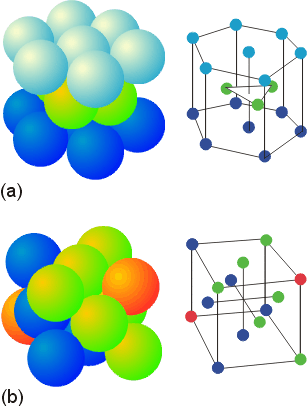
metallic solids - these involve non-directional covalent bonds using electrons that are delocalized throughout the crystal. They conduct electricity, are ductile and malleable, and have varying degrees of hardness and a wide range of melting points. Metal atoms are considered to be spherical atoms packed in a closest packing arrangement. Six nearest neighbors in a layer surround each sphere, and then atoms are layered above and below the plane of the first layer. The properties of metal, conductivity, luster, malleability, etc., can be related to the structure of the solid.
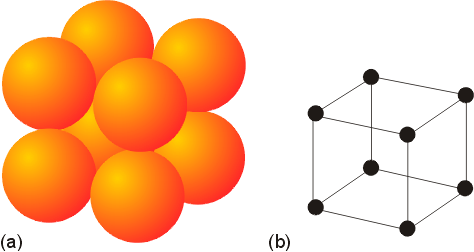
Metals which are close-packed can adopt either a hexagonal close-packed or a cubic close-packed (face centered cubic) unit cell.Other unit cells adopted by some metals (under specific conditions) include bond-centered cubic and simple cubic arrangements. atomic solids - these involve London dispersion forces, and are found in the noble gases. These elements usually have very low melting and boiling points.
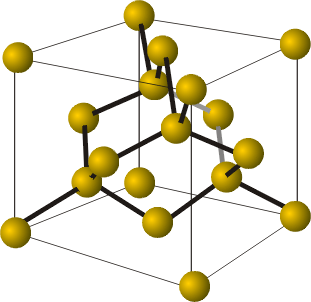
covalent or network solids - these contain directional covalent bonds between the atoms. They can be extremely hard (diamond), with high melting points. Some compounds, such as SiO2, also contain covalent bonds throughout the solid.
A new class of carbon compounds, called fullerenes or Bucky balls are based on a soccor ball type structure with the formula C60. The structure consists of planar 5 and 6-membered rings which form a round, hard structure.Carbon forms a variety of solids held together in different arrangments of covalent bonds. Graphite consists of planar sheets of sp2 bonded rings which are loosely held together by London forces. The structure shows great tensile strength and electrical conductivity in the plane of the rings.
Diamond has a three dimensional array of sp3 hybridized bonds which creates an extremely hard substance.These solids are held together by dipole-dipole attractions (in polar molecules) and/or London dispersion forces. As a result, these solids are usually soft, with low melting points. Molecular Solids
These solids are held together by a three dimensional pattern of alternating positive and negative ions. The pattern, or unit cell, is determined by X-ray. These solids are hard, brittle, and have high melting points. The type of unit cell (face-centered cubic, body centered cubic, etc.) can be used to determine the number of ions in the compound. For each position in the cube, the percentage of the ion within the unit cell can be determined. Ions in the corners of the cube are only 1/8 within the unit cell. Faces are ½ within the cell, and edges are ¼ within the cell. Ionic Solids
Return to Class Schedule
Copyright ©1998 Beverly J. Volicer and Steven F. Tello, UMass Lowell. You may freely edit these pages for use in a non-profit, educational setting. Please include this copyright notice on all pages.