Multifunctional Fabrics
Sub-Areas
Anti-Microbial
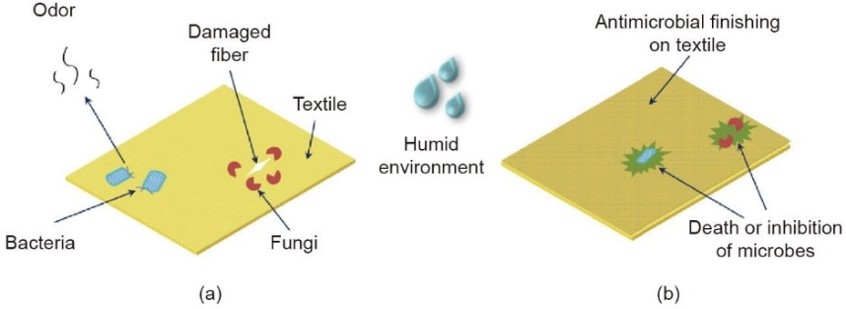
Antimicrobial fabrics are next-generation textiles engineered to inhibit the growth of bacteria, fungi, and viruses, enhancing hygiene, safety, and long-term durability. In an era marked by rising infectious diseases and antimicrobial resistance, these advanced materials are transforming healthcare, sportswear, and daily-use apparel by offering continuous protection against microbial contamination. Among various antimicrobial agents, polyhexamethylene biguanide (PHMB) and epsilon poly-L-lysine (ε-PL) stand out for their broad-spectrum antimicrobial activity, excellent biocompatibility, and environmental safety. When covalently grafted onto cotton or nylon fibers, PHMB and ε-PL form a stable antimicrobial network that remains effective even after repeated washing and extended use. This chemical bonding ensures long-lasting protection, preventing bacterial colonization, odor formation, and material degradation. This eco-friendly and scalable coating technology opens new opportunities for developing high-performance fabrics tailored for medical and hygiene applications, including wound dressings, surgical gowns, face masks, uniforms, and protective clothing. By combining durability, comfort, and safety, PHMB/ε-PL-functionalized textiles contribute to cleaner environments, reduced infection risks, and a more sustainable future in both healthcare and consumer sectors.
Chem-Bio Protection
Halogen-Free Flame-Retardant Coatings
We focus on developing eco-friendly, halogen-free, organic flame-retardant coatings for a wide range of textile fabrics, including cotton, nylon, polyester, and NyCo (nylon–cotton) blends. Conventional halogenated flame retardants pose significant environmental and health risks due to the release of toxic and corrosive by-products during combustion. In contrast, our research emphasizes sustainable phosphorus-, nitrogen-, and silicon-based organic systems that provide high flame retardancy without compromising fabric integrity or environmental safety. To achieve this, we employ surface modification, sol–gel processing, and electrospinning to fabricate thin, uniform, and multifunctional coatings. Our ongoing work aims to elucidate the structure–property relationships governing flame retardancy in coated textiles, driving the development of durable, high-performance, and eco-responsible protective fabrics. These materials have broad applications in military uniforms, aerospace composites, and next-generation technical textiles, bridging the gap between safety, sustainability, and advanced material innovation.