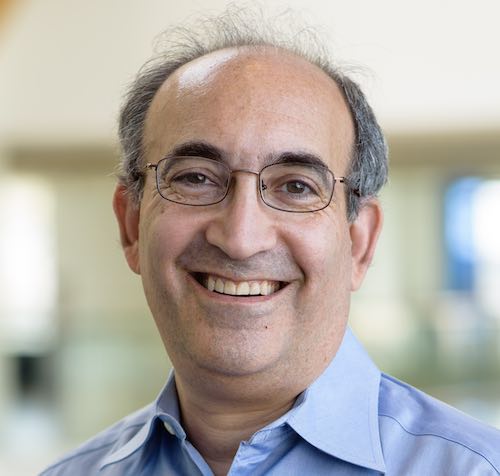
Prof. James Propp
UMass Lowell
Department of Mathematical Sciences

Office: Olsen Hall 428C (U. Mass. Lowell)
Phone: 978-934-2438
Office Hours: Wednesdays: 1:30-2:30; Thursdays: 11:30-12:30.
The best way to contact me is to send email to jpropp at cs dot uml dot edu.


For information on Honors Calculus II (course 92.142) in Spring 2008, click here.

My research interests are in combinatorics, probability, and dynamical systems. Preprints and reprints of many of my articles are available on-line, as are slides from some of my talks.

To find out more about my research, you can look at my two most recent grant proposals to find out (some of) what I've been doing recently and what I want to do next. The first proposal, entitled "Integrable Recurrence Relations and Combinatorics", was funded by the National Security Agency, covering the period March 2004 through February 2006. The second proposal, entitled "Quasirandomness in Discrete Probability Theory", is funded by the National Science Foundation, covering the period July 2006 through June 2009. (For more about quasirandomness, click here.) Both research projects involve undergraduate research assistants as well as graduate students.

My resume (last updated November 2005) is available as a pdf file.

I moderate two email forums: the "domino" forum (founded by Greg Kuperberg back in 1993) and the "robbins" forum (founded by me in 2000). The domino forum is dedicated to a particular flavor of research combining combinatorics, probability, and statistical mechanics (some but not all of which relate in some way to the study of tilings of plane regions by dominos). The robbins forum is named after the late David Robbins and is dedicated to sequences and arrays satisfying various sorts of quadratic recurrence relations (e.g., Somos sequences) and the combinatorial objects that these sequences and arrays enumerate. The domino forum archive is private, but you can look at the archive of the robbins forum.

My collaborators and I have created software related to my research interests in cellular automata and tilings.

I ran a group at UW Madison called the Spatial Systems Laboratory, in which I collaborated with undergraduates and graduate students in trying to understand some simple models of spatial processes, using both theoretical analysis and computer simulation. We called the group SSL (pronounced "sizzle") for short. In its first year, the group (which was funded by NSF's VIGRE initiative) explored abelian sandpile models. (Our group tee-shirt depicts the mysterious "sandpile identity state" for a square grid.) More recently (Spring 2001) we studied tilings (principally domino-tilings and lozenge-tilings) and related combinatorial models (such as the densely packed flux line model). In the Fall 2003 and Spring 2004 semesters, SSL focussed on integrable combinatorial models.

In conjunction with SSL, I taught Math 491 (Topics in Undergraduate Mathematics: Algebraic Combinatorics) in Fall 2003. This course prepared students to conduct original research in low-dimensional combinatorics. Methods taught included recurrence relations (linear and non-linear), transfer matrices, and generating functions; special topics included lattice paths, tilings, trees, routings, matchings, and alternating sign matrices. There was an emphasis on discovery and the use of computers.

I spent the years 2001-2003 on leave, serving as a visiting professor at the Harvard mathematics department during the 2001-2002 academic year and as a visiting professor at the Brandeis mathematics department during the 2002-2003 academic year. While in the Boston area, I ran a two-year-long program called Research Experiences in Algebraic Combinatorics at Harvard ("REACH"), in which I enlisted the aid of undergrads and graduate students in the Boston area as partners in my research in combinatorics. (If you like to wear mathematics on your upper body, check out the tee-shirt that the group made to illustrate one of its main advances.) During Fall 2001 I taught a combinatorics course (as sort of a feeder for students involved with REACH); all course materials (including videos of the lectures) are available over the web. There is a substantial overlap between the work done by REACH and the work done by SSL during the 2003-2004 academic year.

During my last five years teaching at MIT I ran the (mostly undergraduate) Tilings Research Group under the auspices of MIT's Undergraduate Research Opportunities Program; you can look around a little bit in our communal Web-site by clicking here. You can also check out the front and back of our 1996 group tee-shirt, the front and back of our 1997 group tee-shirt, and the front and back of our 1998 group tee-shirt. (I've created both technical and non-technical explanations of the 1998 shirt.)

Courses I have taught at UW Madison include (in reverse chronological order) Introduction to Combinatorics (Math 475), Algebraic Combinatorics (Math 491), An Introduction to Probability Theory (Math 431), Elementary Number Theory (Math 567), Probability Theory (Part II) (Math 832), Fermat's Last Theorem in Context (a discussion-based seminar; Math 491), and Arithmetical Problem Solving (Math 130). I have made the solutions to the problem-sets and exams unreadable. If you have a valid reason for gaining access to these materials, contact me by email.

For earlier courses (taught at MIT), click here. To get a sense of my style and philosophy of teaching, you can look at something I wrote the last time I applied for a job that required a "teaching statement", as well as a list of things I usually say on the first day of class. (You can also see some actual videos of my lectures on combinatorics.)

My biggest expository writing project is a book on Fermat's Last Theorem (for the scientifically interested public, not number theorists), to be published by Princeton University Press, entitled "Who Proved Fermat's Theorem?: The Curious Incident of the Boasting Frenchman." I don't have a draft available that I'm ready to circulate, but in the meantime you can check out a short article of mine entitled "Fermat's Last Theorem and the Fourth Dimension".

Sometimes I teach workshops on "Choreographic Topology". You can see three not-so-recent photos of what this choreographic topology looks like (courtesy of Fabian Theis).

I've collected some pointers to interesting mathematical Web-sites.

If you like puzzles, click here.

My contact sport is parallel parking.

How many college professors does it take to change a lightbulb?

My wife Sandi Gubin is a psychologist with her own domain.

My Nick Park number is 2 (click here and here for details).

If you have any suggestions for this web-page or questions about my work, send email to propp at jamespropp dot org or to James_Propp at uml dot edu.

Last updated July 11, 2007.